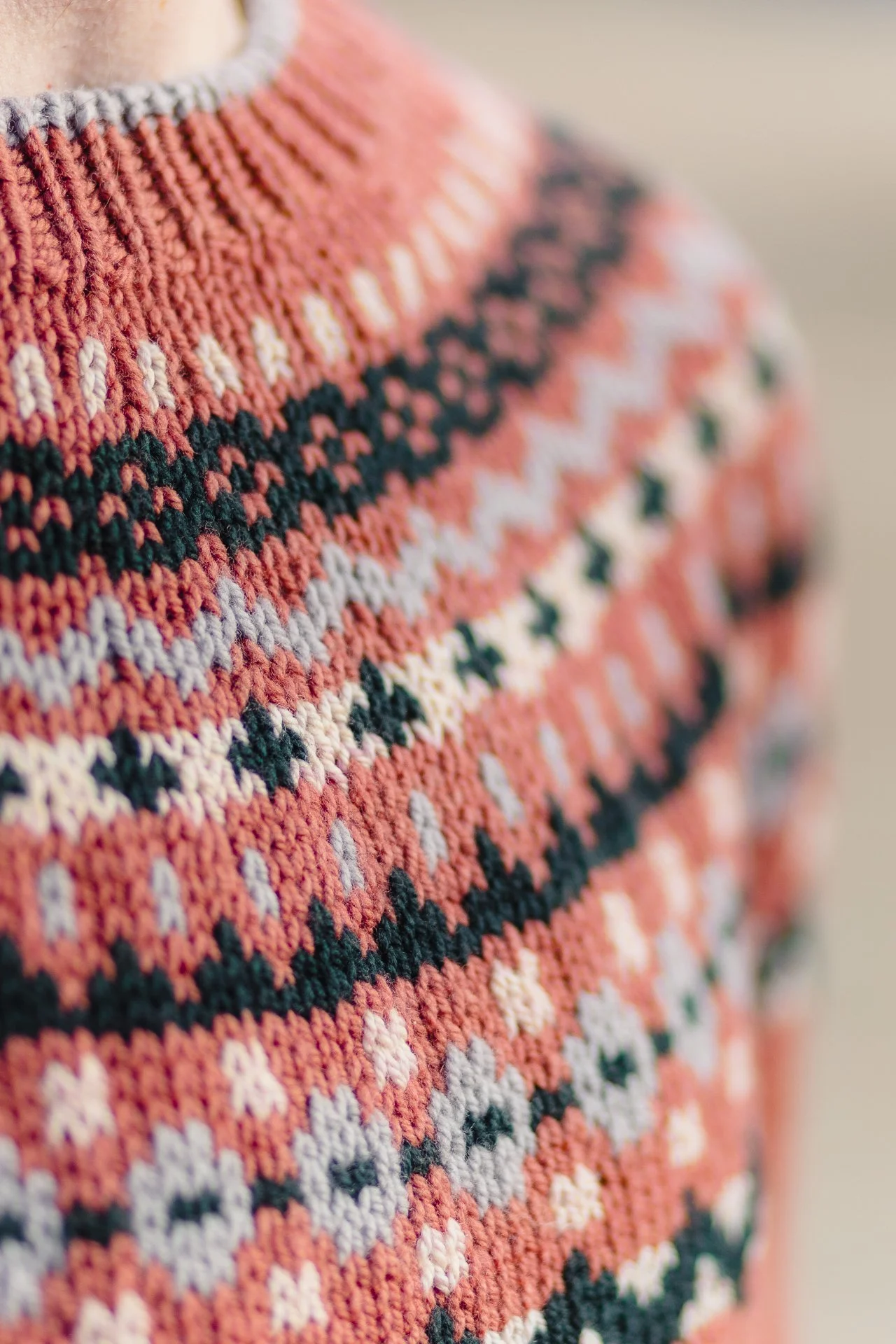
Shaniko Sweater
THE SHANIKO SWEATER takes its name from Shaniko, Oregon(1)—once known as the wool capital of the world in the early 1900s. At its height, Shaniko was a hub of sheep ranching and wool production, a place shaped by fiber, labor, and the rhythms of rural life. That history felt like the perfect foundation for a sweater rooted in tradition, yet designed for modern knitters.
From the beginning, my goal with this design was to create a colorwork sweater that feels welcoming rather than intimidating. The motifs are thoughtfully scaled, only two colors are worked at a time, and the shaping is kept separate from the colorwork so you can settle into a steady, rhythmic flow. Whether this is your first colorwork garment or simply your next one, the Shaniko Sweater is designed to help you build confidence stitch by stitch.
If you’re brand new to colorwork—or just want a low-pressure way to practice—I’ve also designed companion Shaniko Hat and Shaniko Cowl patterns. These smaller projects let you get comfortable with the motifs, test your color choices, and dial in your gauge before casting on the sweater, all on a more manageable canvas.
Together, these designs are an invitation to slow down, connect with fiber history, and enjoy the simple pleasure of watching pattern and color come together in your hands.
(1)The area around Shaniko, Oregon, is within the traditional territories of several Indigenous peoples, particularly the Confederated Tribes of Warm Springs (Wasco, Warm Springs, and Paiute), though specific ancestral land claims for the immediate Shaniko site point toward broader Columbia Plateau groups like the Wasco and potentially the Cayuse/Nez Perce who frequented Central Oregon, with later treaties impacting these lands, a common thread for all Oregon tribes being the ancestors of the Grand Ronde and Siletz tribes.
-
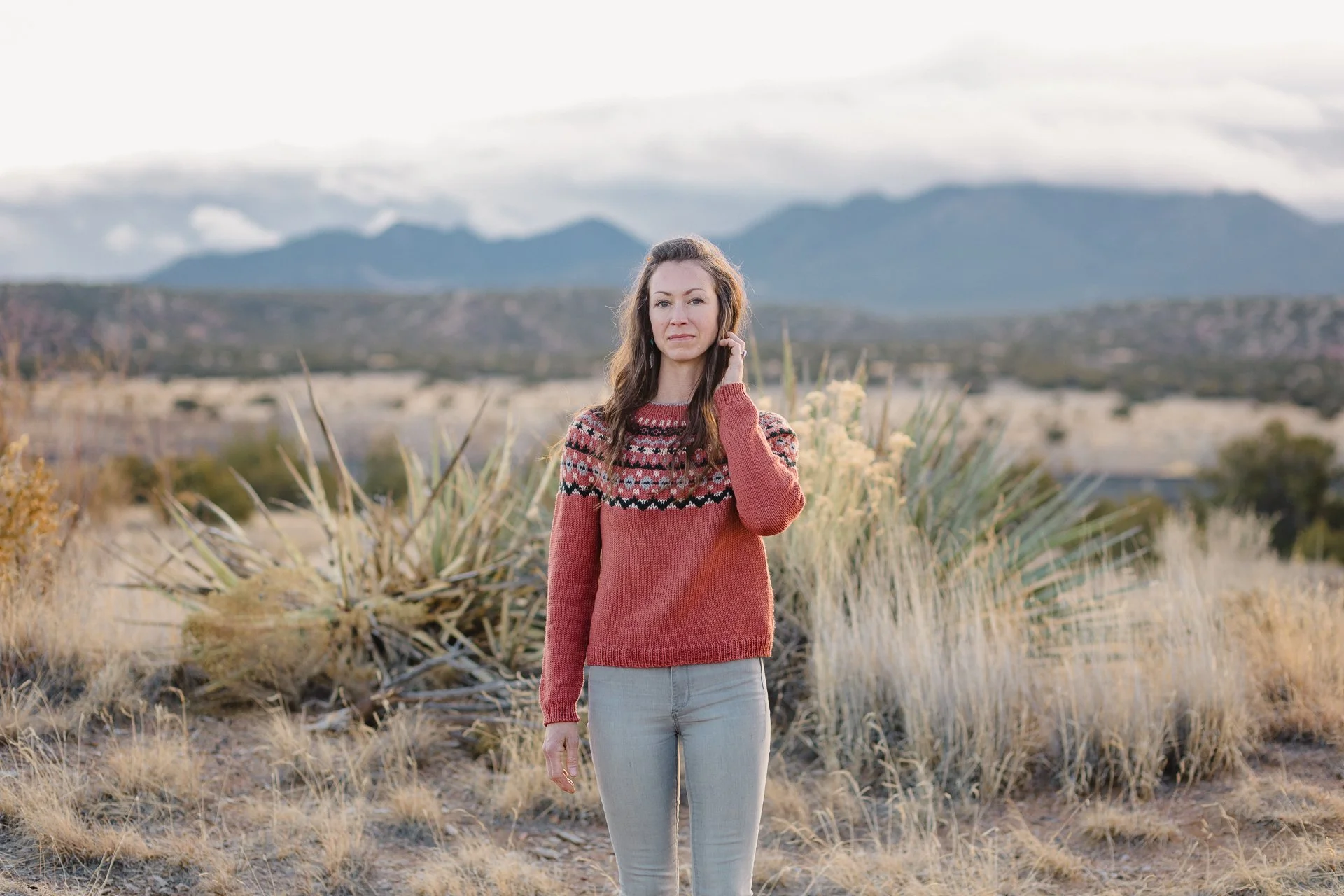
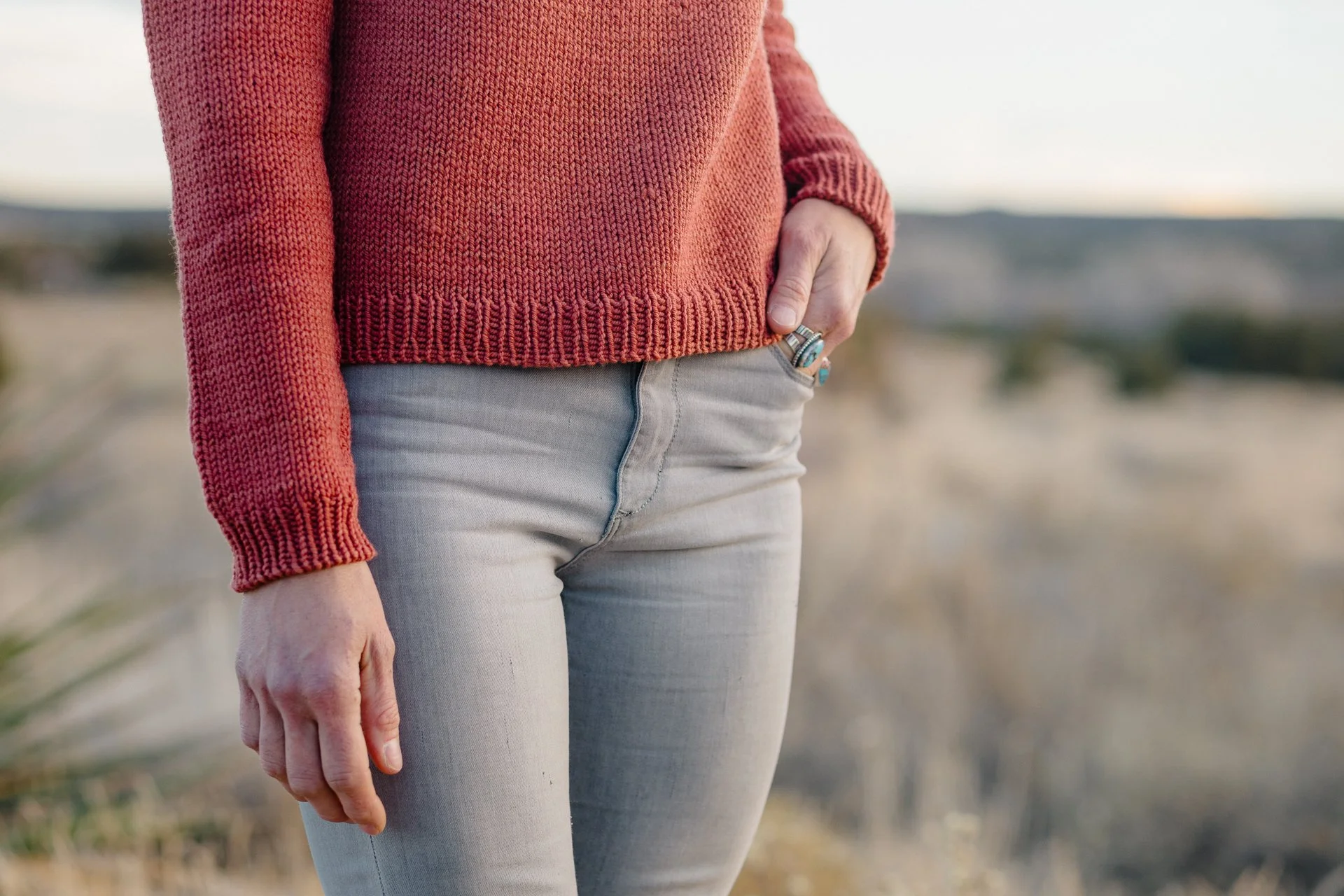
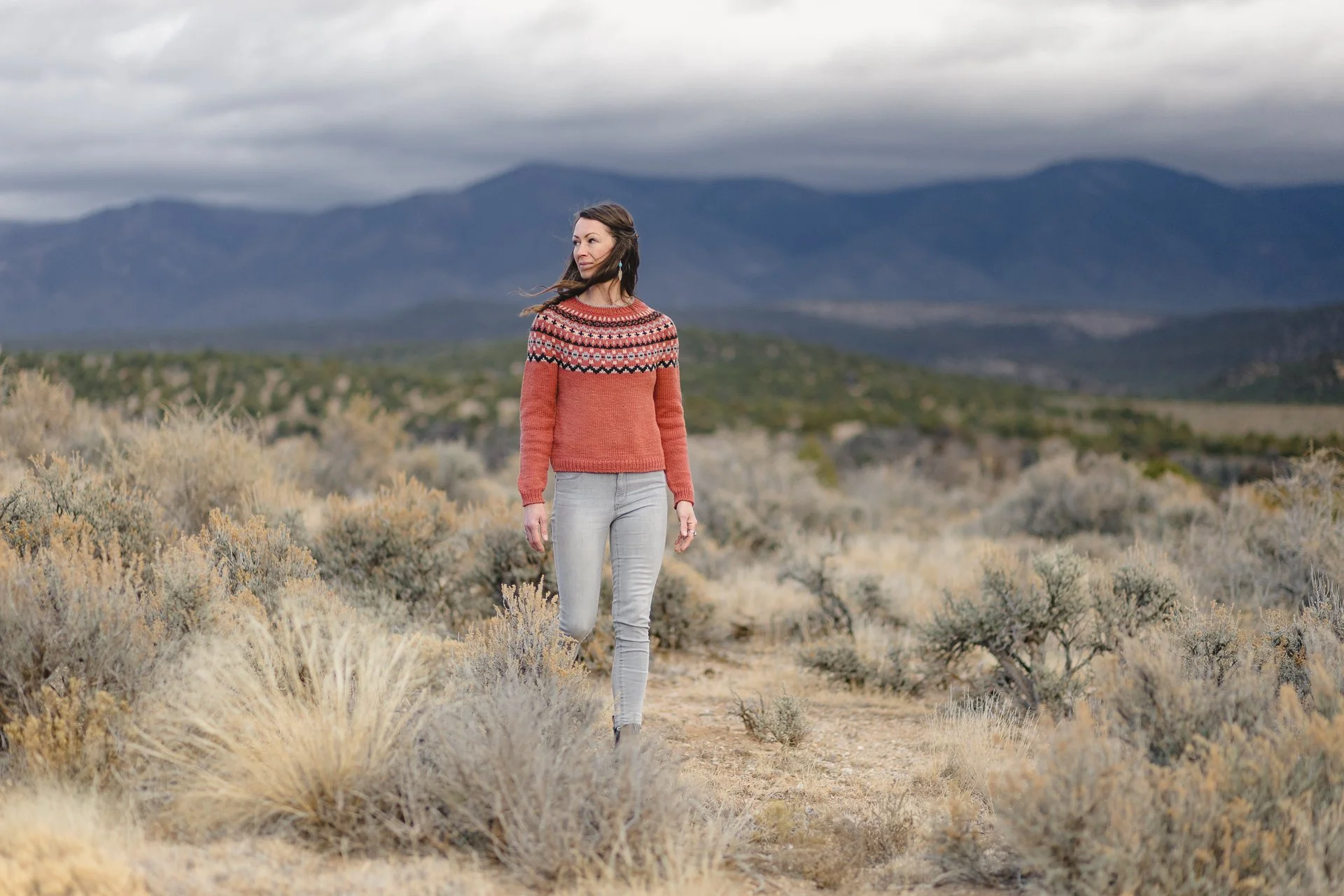
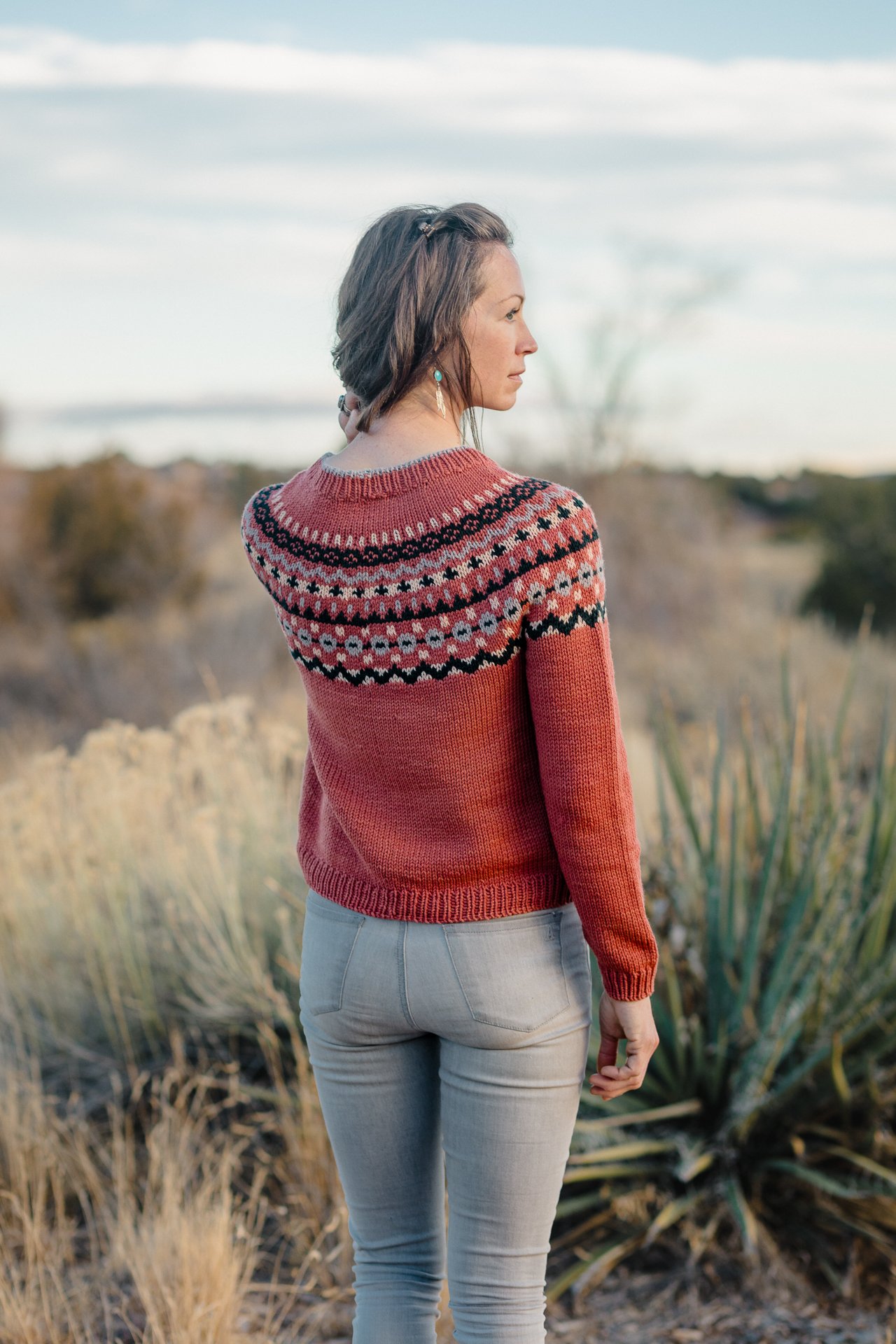
Design: The Shaniko Sweater is a circular yoke pullover with a slightly relaxed, easy-to-wear fit. The yoke features small-scale, southwestern-inspired motifs designed with newer colorwork knitters in mind. Only two colors are ever used per round, motifs avoid long floats, and all increases are worked between colorwork sections to keep the knitting intuitive and approachable. Short rows gently shape the back neck for a comfortable fit. The hem, cuffs, and neckband are finished in classic 1x1 ribbing with a tubular bind-off for a clean, structured edge, and the sleeves taper traditionally for a timeless look.
Construction: This sweater is knit seamlessly from the top down in the round. It begins with a cast-on at the top of the neckband. Once the neckband is complete, short rows shape the back neck for a comfortable fit. The yoke is knit in two-color stranded colorwork with invisible lifted increases placed between motifs to create smooth, gradual yoke shaping. Once the yoke is complete, sleeve stitches are placed on hold while the body is knit. Finally, sleeves are returned to the needles and finished in the round.
Fit: This garment is designed to be worn with 0 to 6 in. (0 to 15 cm) of positive ease at the upper chest. To determine your ideal size, begin by measuring your upper bust (just under the arms, above the full bust). Then add your desired amount of ease and select the size with a finished chest circumference closest to that total. If you are new to choosing a garment size based on your upper bust, I’ve created a road map that walks you through the process.
Yarn: The yarn estimates provided in this pattern are approximations, calculated to allow for both a sizable swatch and the sweater, with a small margin of error. Your actual yarn usage may vary based on factors such as your personal gauge, the yarn’s characteristics (e.g., fiber content, ply, thickness), and any modifications you make to the pattern.
Stitch Patterns: The stranded colorwork stitch pattern in this sweater are only charted, so you should be confident in your chart reading skills—or be open to learning!
Additional Notes: See the Notes section of the pattern for additional info on choosing colors that make the motifs stand out and helpful tips on knitting stranded colorwork.
-
SIZES
(1, 2, 3)(4, 5, 6)(7, 8, 9)FINISHED MEASUREMENTS
Chest Circumference (Upper and Full)
(33.75, 37.25, 41)(44.5, 49, 53.25)(57, 61.25, 64) in.
(84.5, 93, 102.5)(111.5, 122.5, 133)(142.5, 153, 160) cmUpper Arm Circumference
(11.5, 12.5, 13.25)(14.25, 15.5, 17)(18.75, 20, 21.25) in.
(29, 31.5, 33)(35.5, 39, 42.5)(47, 50, 53) cmThis sweater is designed to be worn 0 to 6 in. (0 to 15 cm) of positive ease in the upper chest. The sample is shown in Size 1, worn with 2.75 in. (7 cm) of positive ease at the upper chest and 1.75 in. (4.5 cm) of positive ease at the full chest, in the full length version on a woman who is 5 ft 8 in. (173 cm) tall. See the note above on fit for more information about choosing the right size for you!
-
YARN
This sweater is written for 3 contrast colors, but the design is wonderfully flexible—you can use anywhere from 3 contrast colors up to a full gradient of 13 if you want to get creative. Since each contrast section uses only a small amount of yarn, this pattern is an excellent way to use leftover skeins, minis, or those special scraps you’ve been saving.Worsted weight
Cropped Length
MC: (380, 425, 470)(510, 565, 630)(685, 750, 795) g/(910, 1020, 1130)(1225, 1355, 1510)(1645, 1800, 1910) yds or (830, 935, 1035)(1120, 1240, 1380)(1505, 1645, 1745) mFull Length
MC: (405, 455, 500)(545, 605, 670)(725, 795, 845) g/(970, 1090, 1200)(1310, 1450, 1610)(1740, 1910, 2030) yds or (885, 995, 1095)(1200, 1325, 1470)(1590, 1745, 1855) mCropped and Full Length
CC1: (40, 45, 50)(50, 60, 65)(70, 75, 80) g/(95, 110, 120)(120, 145, 155)(170, 180, 190) yds or (85, 100, 110)(110, 135, 140)(155, 165, 175) m
CC2: (25, 30, 30)(35, 40, 45)(45, 50, 55) g/(60, 70, 70)(85, 95, 110)(110, 120, 130) yds or (55, 65, 65)(80, 85, 100)(100, 110, 120) m
CC3: (25, 30, 30)(35, 40, 40)(45, 50, 55) g/(60, 70, 70)(85, 95, 95)(110, 120, 130) yds or (55, 65, 65)(80, 85, 85)(100, 110, 120) mSUGGESTED YARN
Wool & Palette Shaniko (100 g/240 yds (219 m)) – 100% non-superwash Merino/Rambouillet
Cropped Length
MC: (4, 5, 5)(6, 6, 7)(7, 8, 8) skeins
Full Length
MC: (5, 5, 5)(6, 7, 7)(8, 8, 9) skeins
Cropped and Full Length
CC1: 1 skein
CC3: 1 skein
Spincycle Yarns Dream State (65 g/150 yds (137 m)) – 100% superwash American wool
Cropped and Full Length
CC2: 1 skein
The sample sweater is knit in the colorways Marmalade (MC), Salamander (CC1), Written in the Stars (CC2), and Narwhal (CC3). -
Needle A (body): US 8 (5 mm)
Needle B (ribbing): US 6 (4 mm)For each needle size, you will need circular needles measuring 24 in. (60 cm) to 50 in. (125 cm), depending on the finished chest circumference of your chosen size and your preferred method for smaller circumference knitting (such as magic loop, short circular needles, or double-pointed needles).
-
Measure gauge on Needle A in the round, after blocking.
18 sts and 24 rows = 4 in. (10 cm) in stockinette
18 sts and 22 rows = 4 in. (10 cm) in stranded colorwork -
Knitting
Purling
Increasing
Decreasing
Circular yoke construction
Top-down construction
Knitting in the round
Tubular cast-on
German short rows
Lifted increases
Right lifted increases (RLI)
Left lifted increases (LLI)
Stranded colorwork
1x1 ribbing
Backwards loop cast-on
Picking up stitches
Tubular bind-off