Paintbrush Pullover
EVERY TIME I ENCOUNTER a paintbrush flower, I momentarily lose my breath. It feels like a small miracle that these springy bursts of color are real, living things. Paintbrush flowers—members of the genus Castilleja—are often associated with transformation, intuition, and creativity.
When I first designed the Paintbrush Tank several years ago, I thought I was taking creative license. Paintbrush is hemiparasitic, typically found in small clusters scattered among lupines and other nitrogen-fixing plants—a few blossoms dotting a meadow here and there, not the sweeping fields suggested by the repeating motifs in that original design.
And then, last June, I stumbled upon something I had never seen before: field after field of paintbrush flowers stretching as far as the eye could see at a climbing area along the southern edge of Wyoming’s Wind River Range. It felt unreal—like walking into a dream. Even now, I can hardly believe my memory of it!
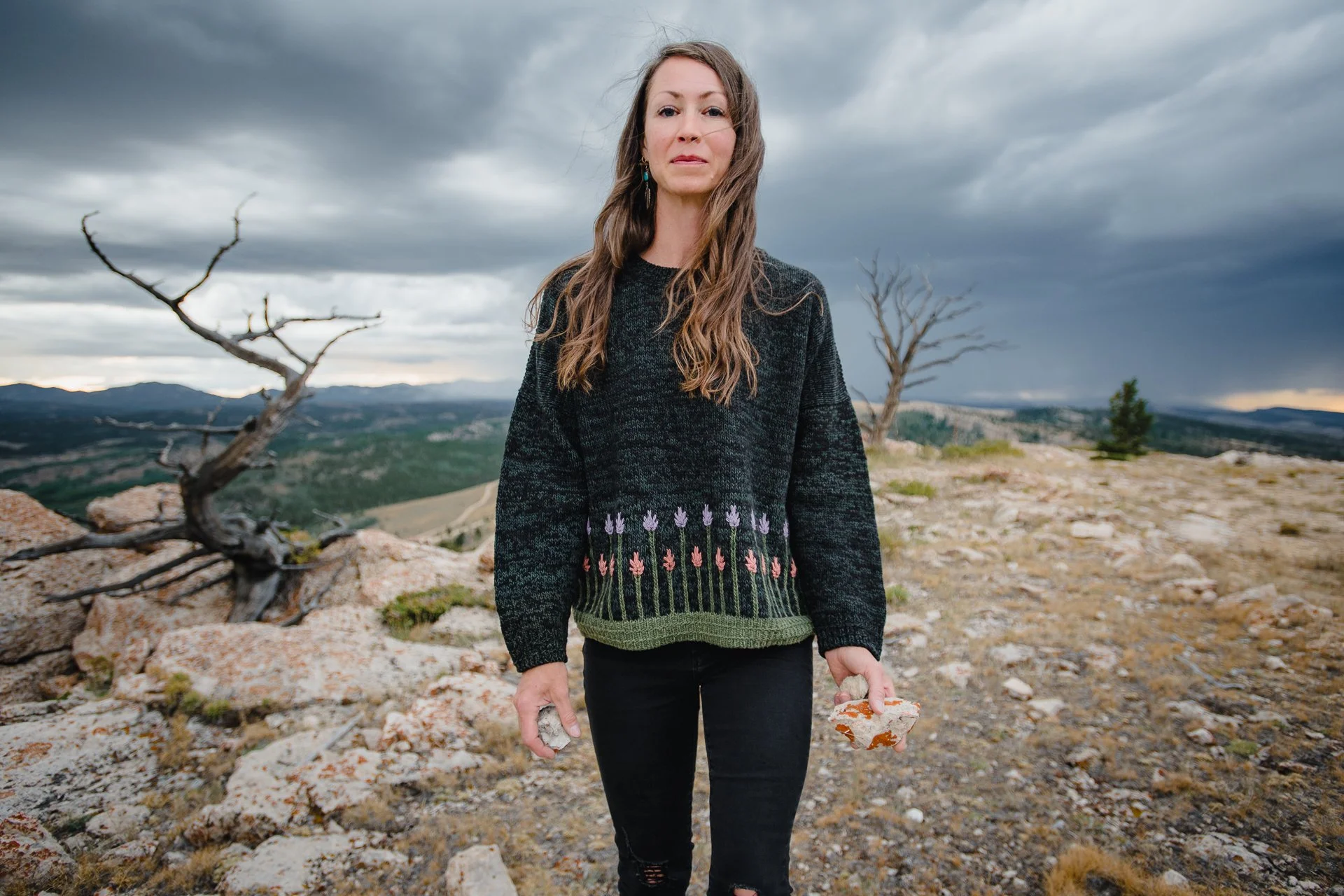
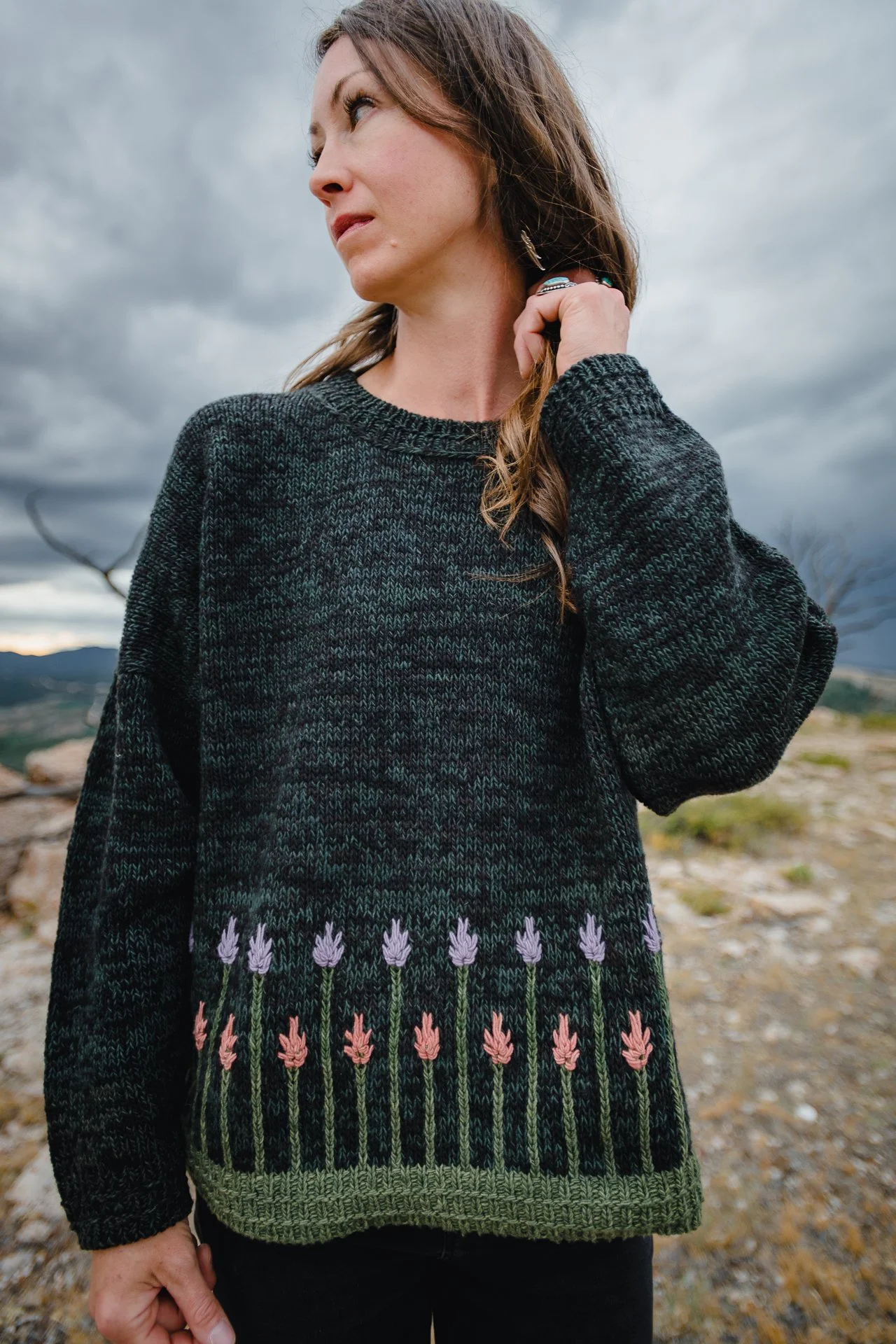
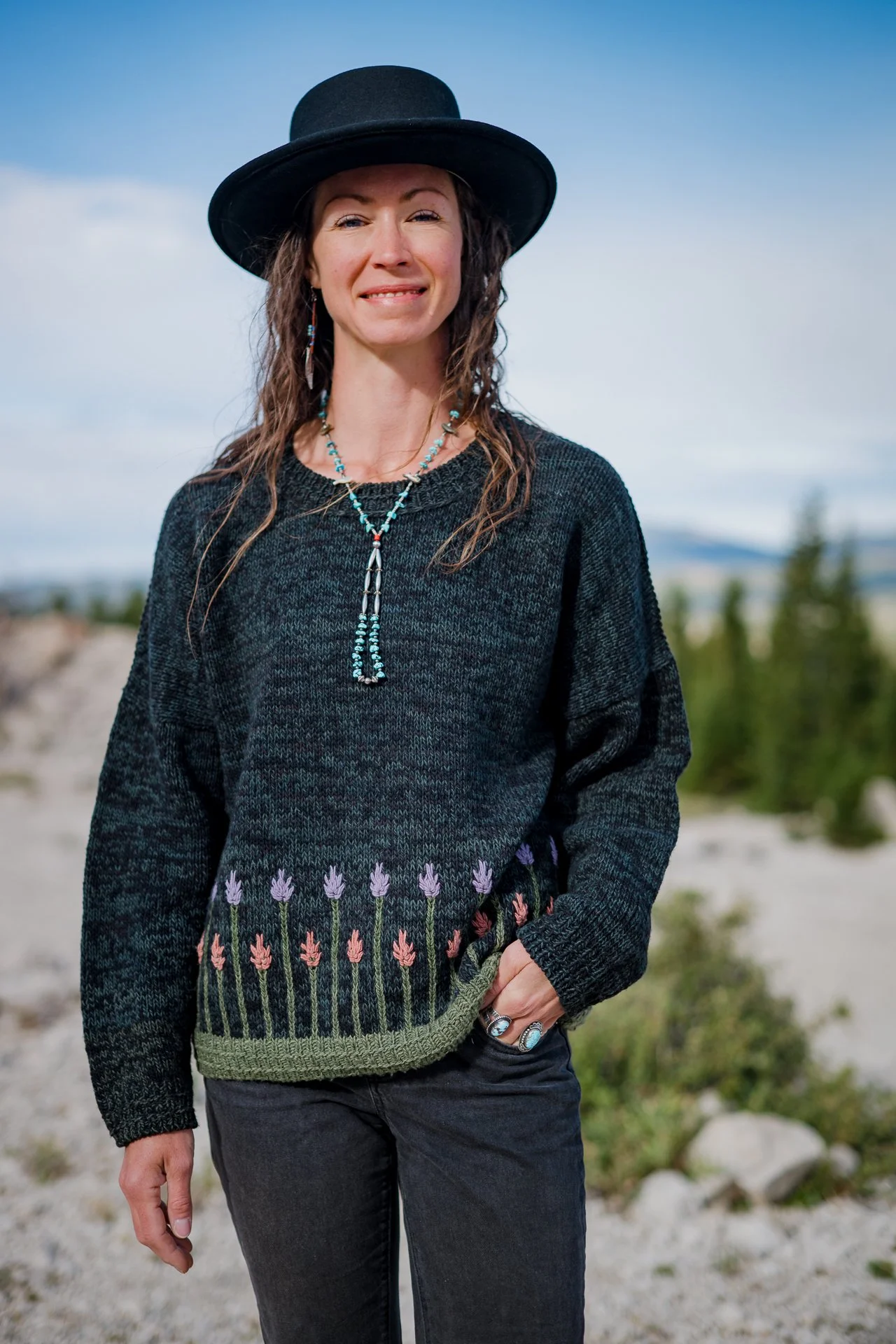
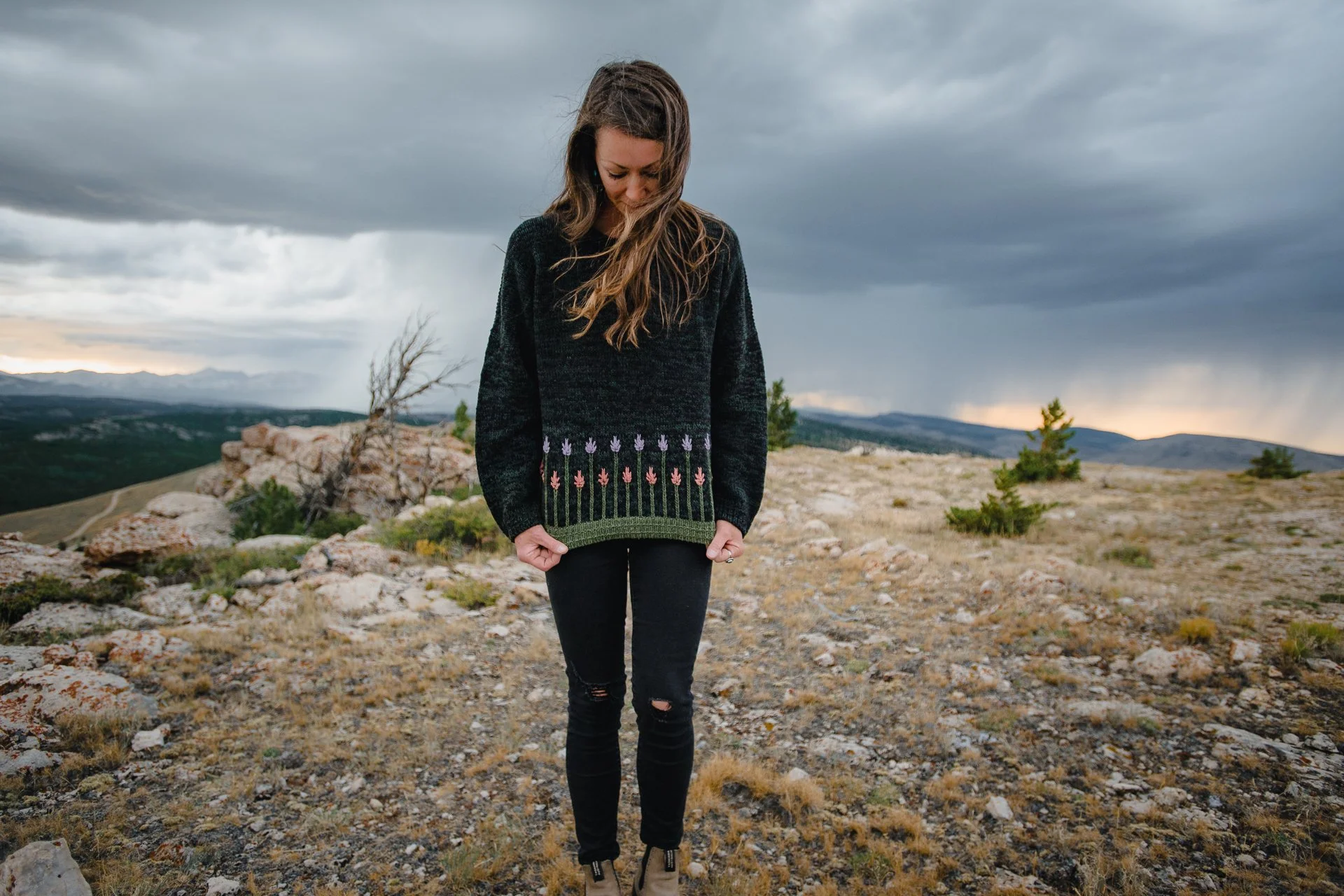
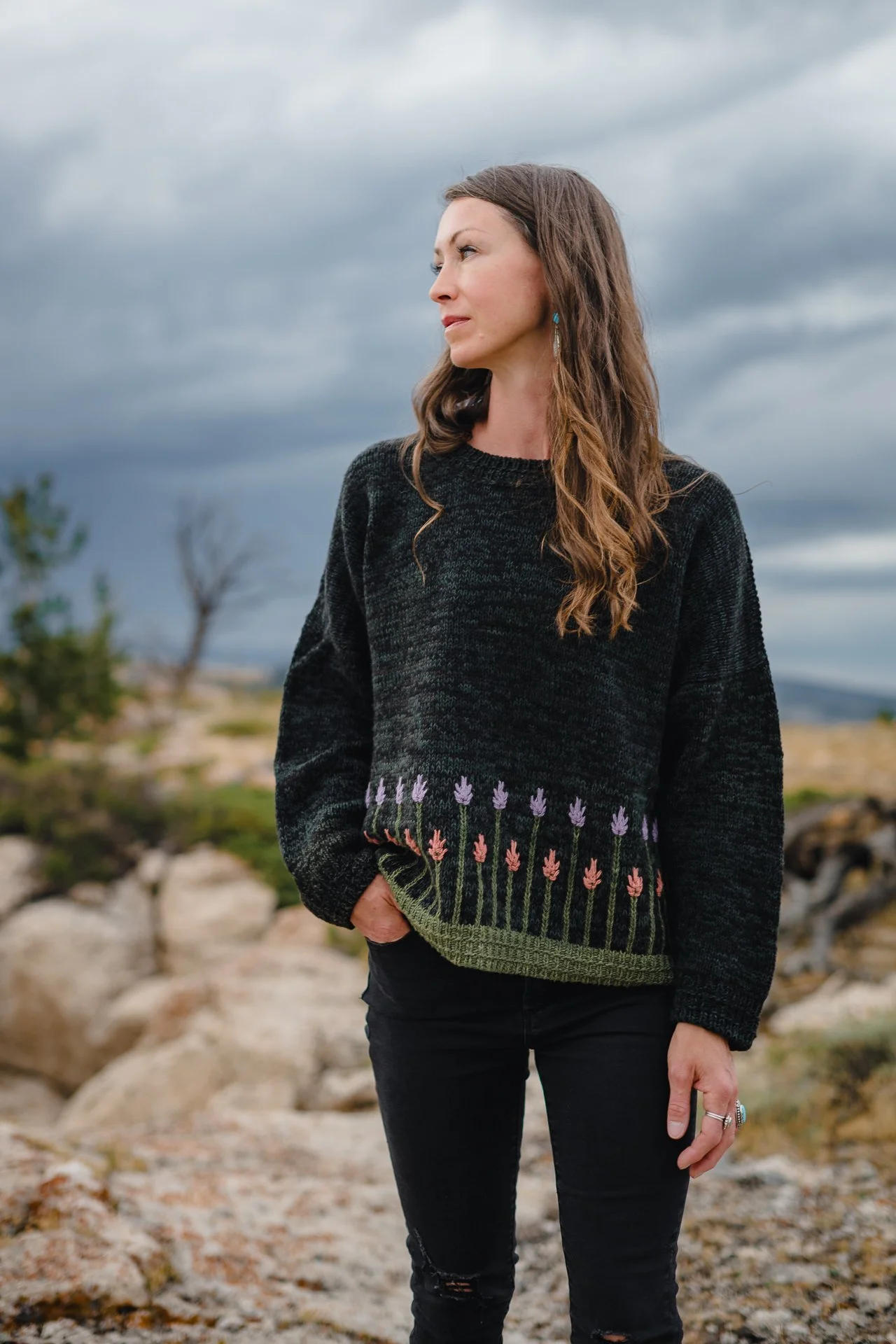
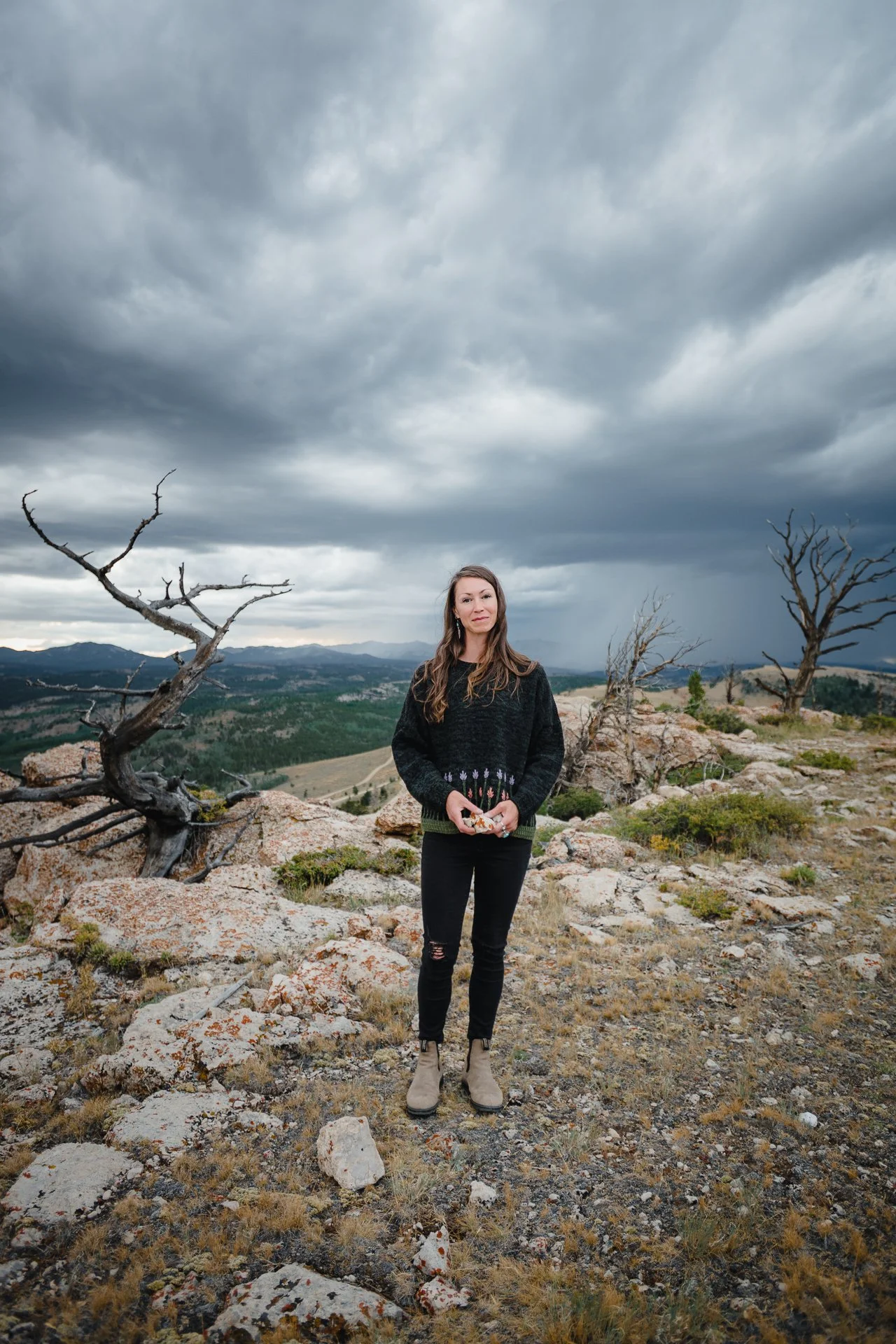
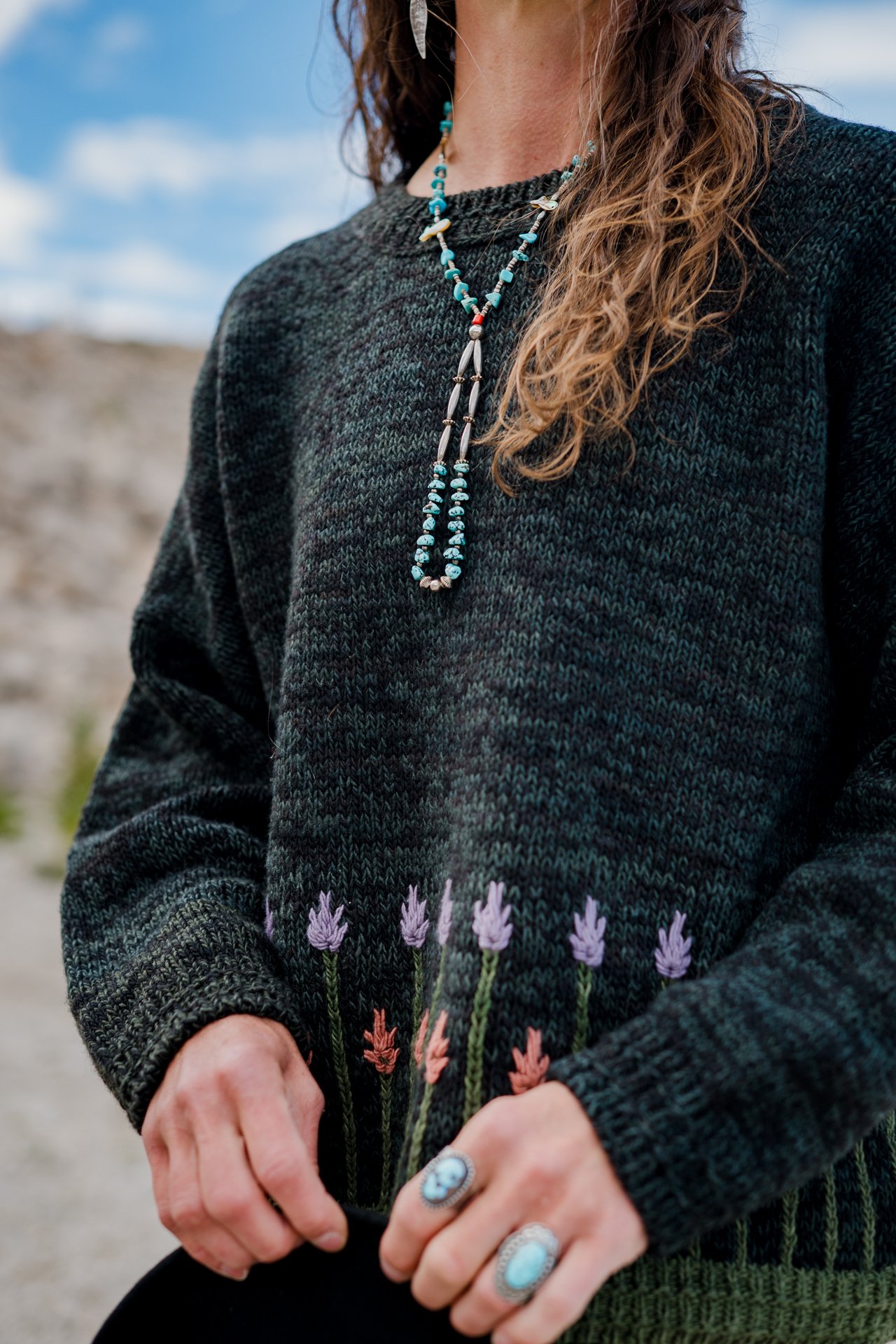
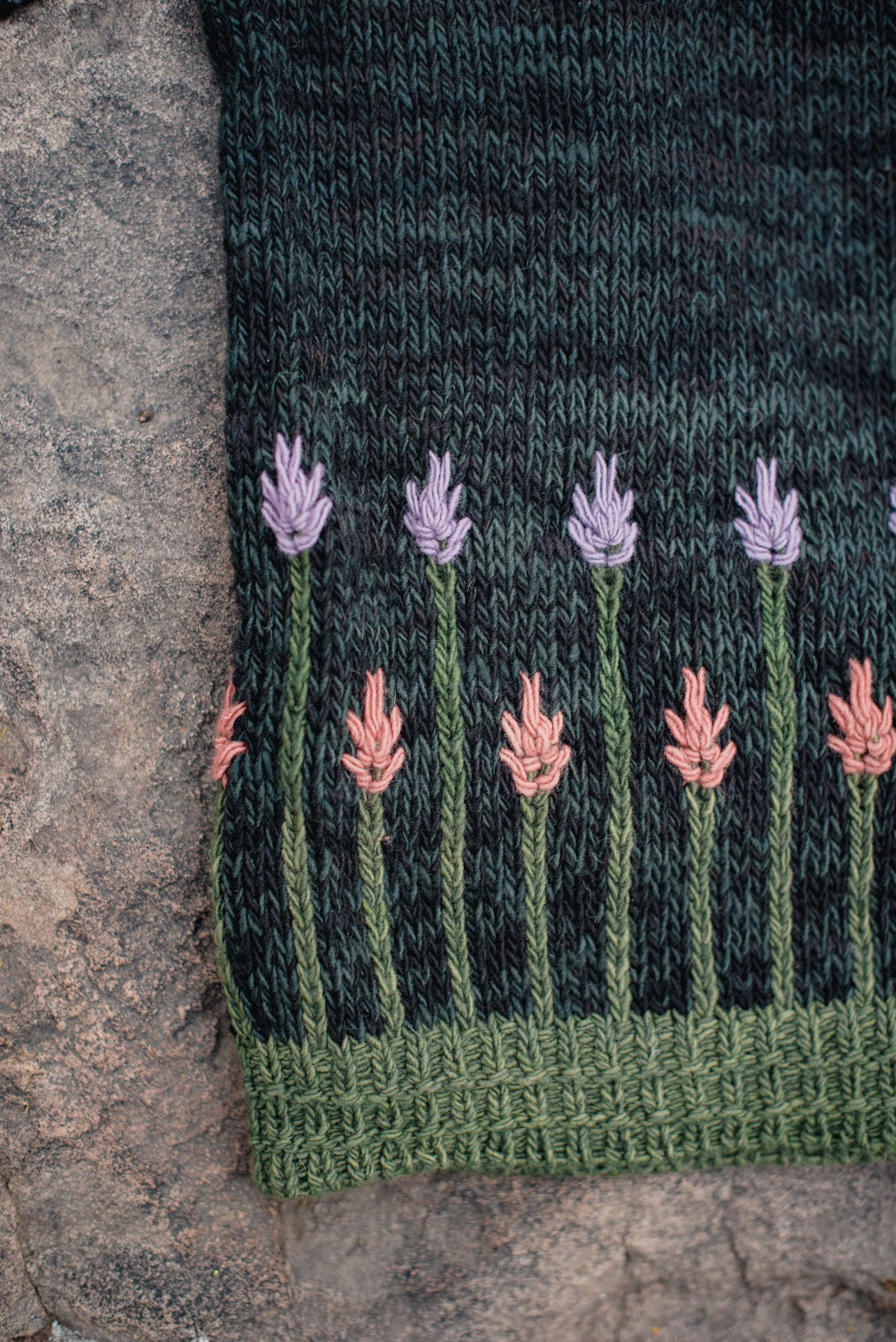
With this vision in mind, I revisited the paintbrush motif. This time, I reimagined the scene under moonlight. The background is worked by holding black together with deep green-gray, creating a shimmering effect that evokes moonlight across a dark meadow. Instead of the fiery reds and oranges of daylight paintbrush, the blossoms bloom in bright pink and lavender—a slightly more magical, fairytale interpretation of that unforgettable Wyoming landscape.
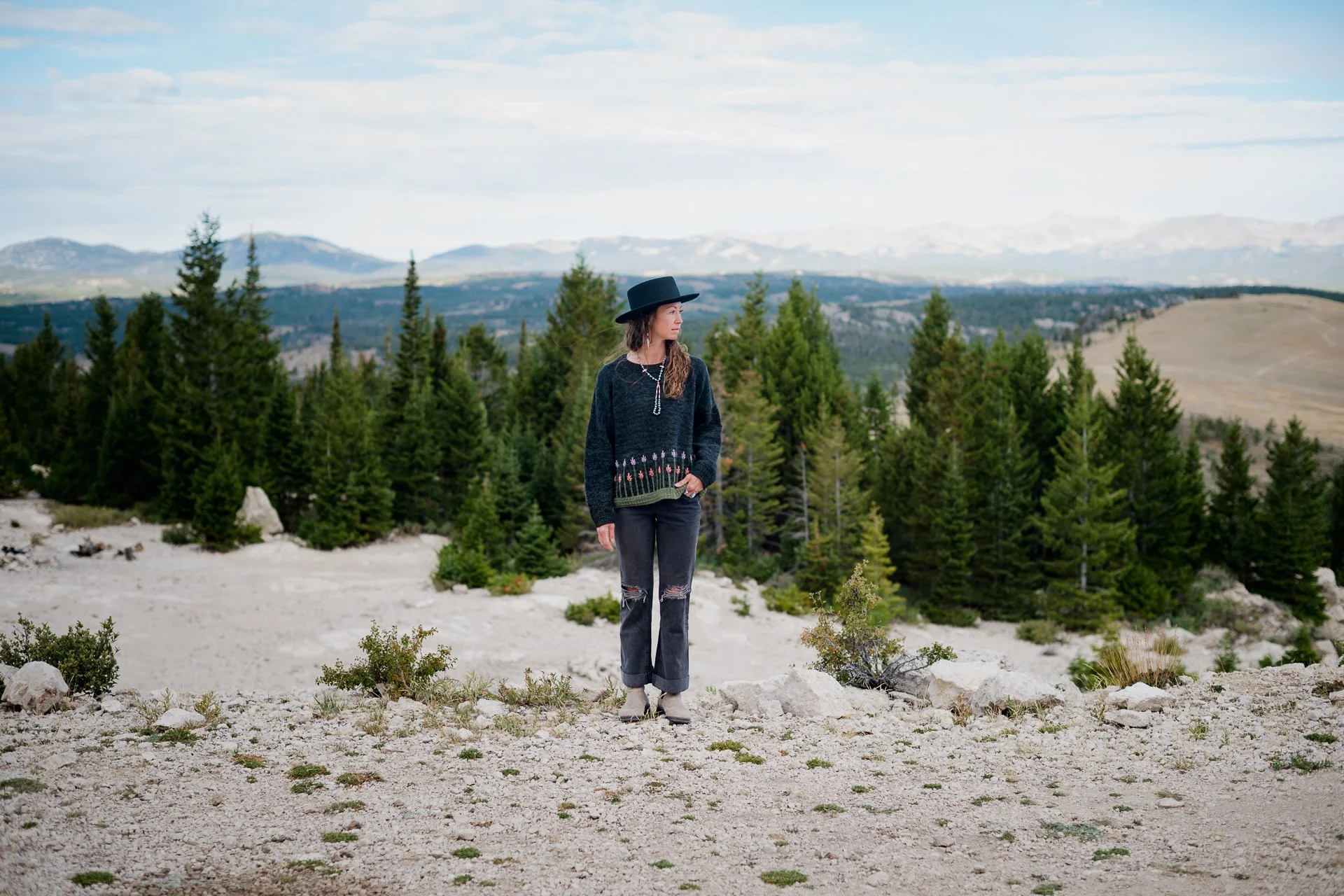
With its cozy modified drop-shoulder silhouette and clean, tailored neckline, this sweater is perfect for cool evenings—whether you’re gathered around a summer bonfire or pulling on an extra layer as autumn begins to give way to winter.
And one more thing: the flowers are much simpler to work than they might look. Knit a small swatch to practice the motif, and you’ll have it memorized in no time. I’ve included both written and charted instructions so you can learn whichever way works best for you.
-
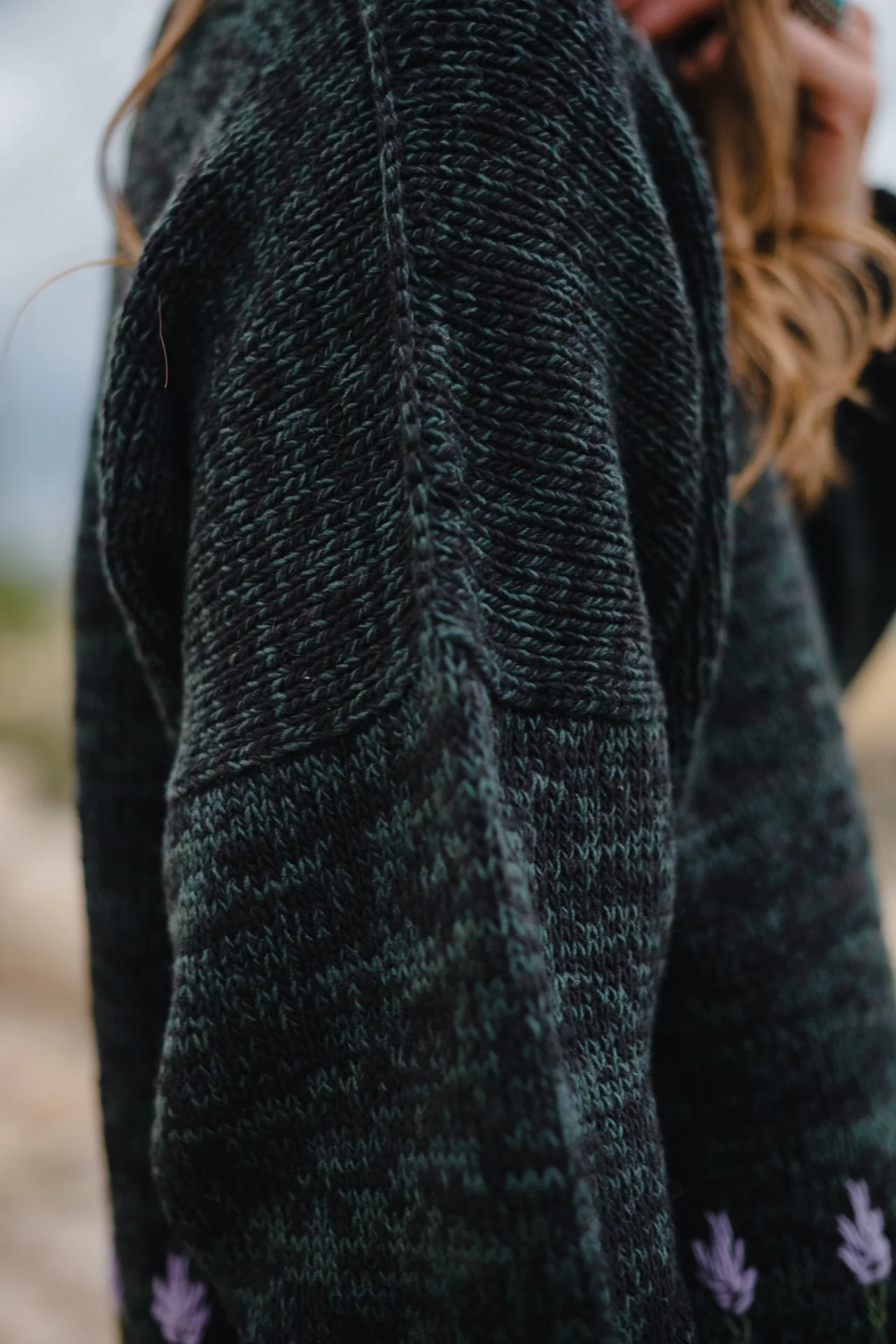
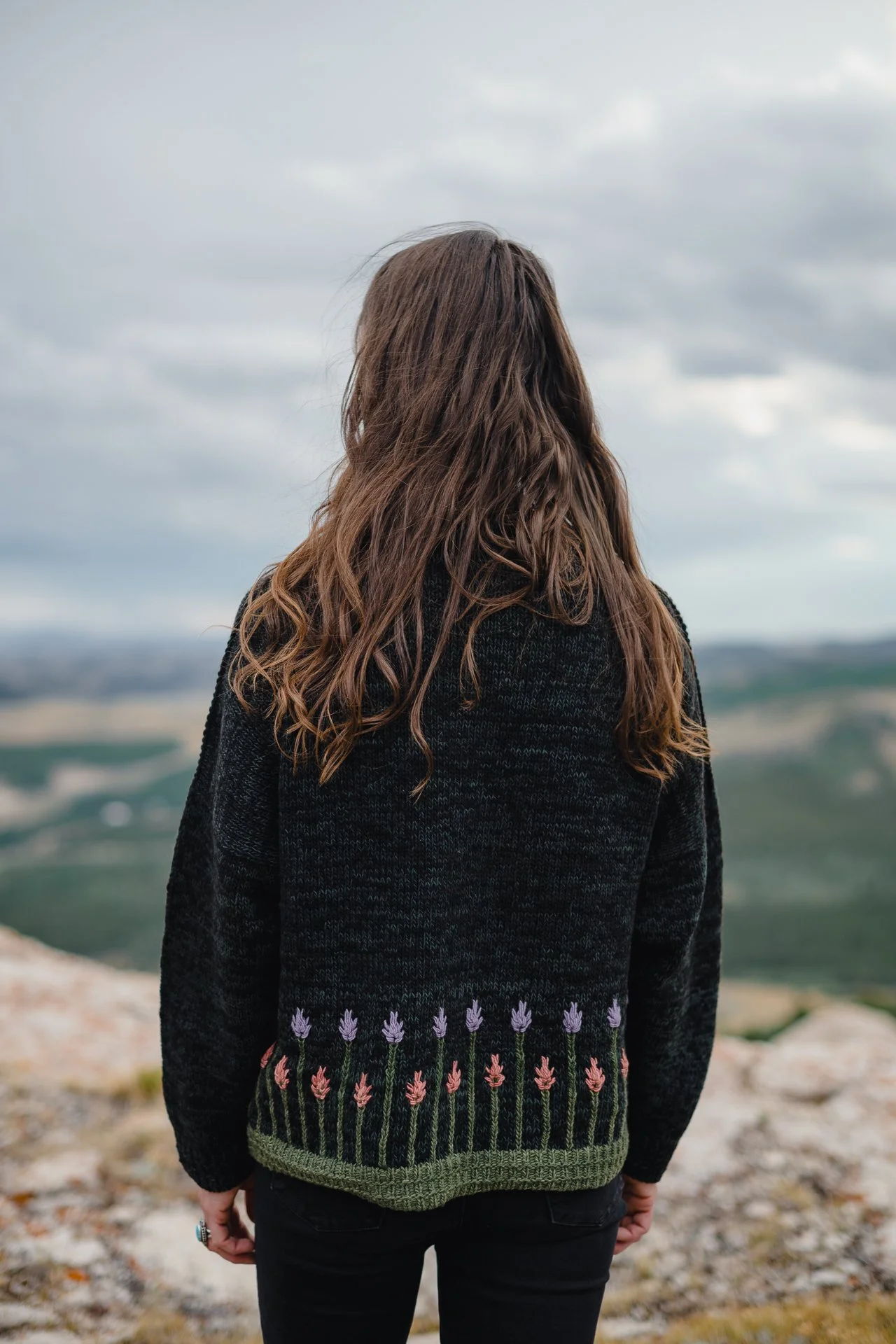
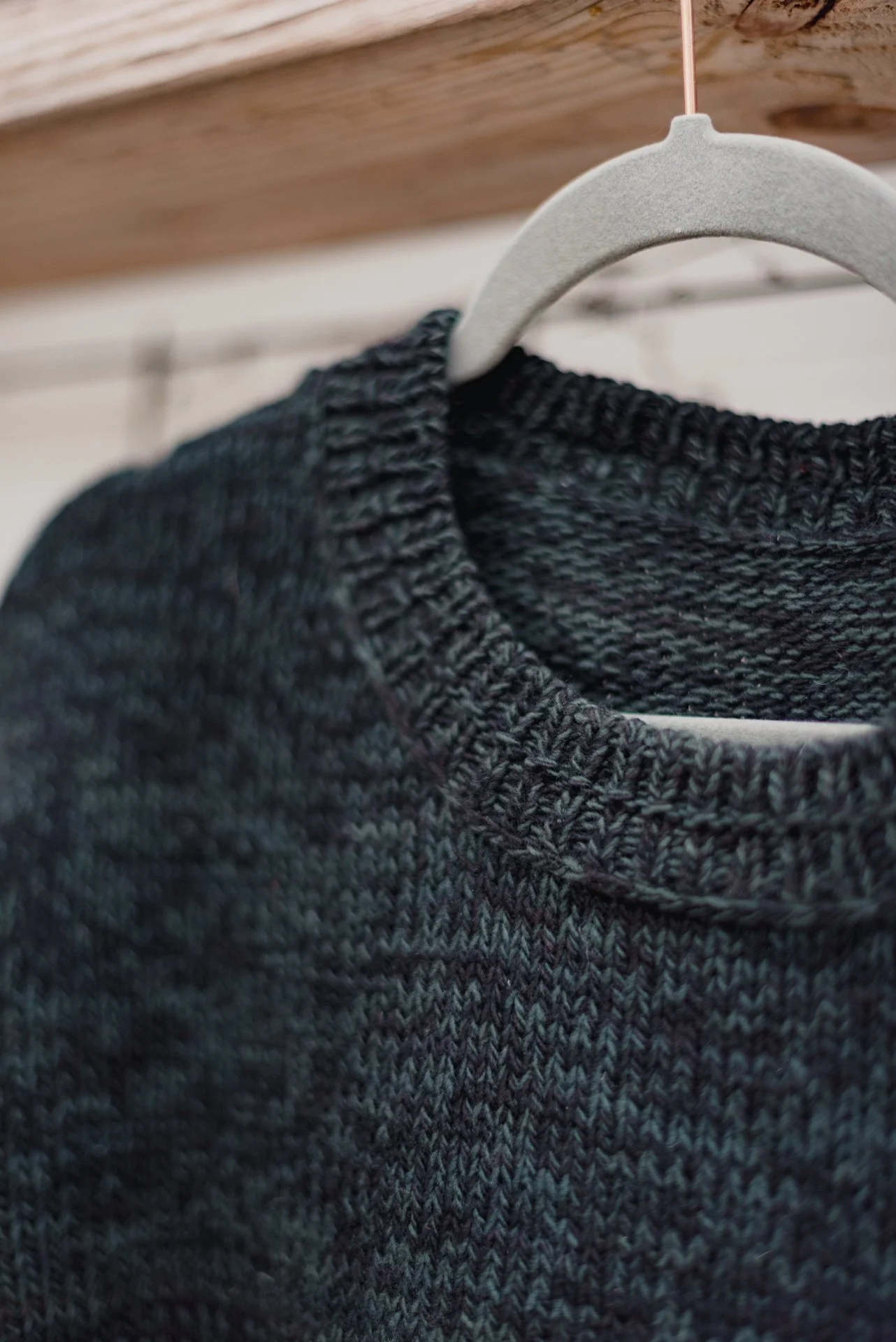
Design: The Paintbrush Pullover is a modified drop-shoulder sweater designed with a relaxed, effortless fit. The lower body features a combination of stranded colorwork and slipped stitches that create a field of paintbrush flowers. The hem, neckband, and sleeve cuffs are worked in 1x1 broken ribbing. A Vikkel braid at the base of the neckband and exposed shoulder seams lend a tailored, polished finish to this otherwise easy-going silhouette.
Construction: This sweater is worked from the bottom up with minimal seaming. The hem and lower body are knit in the round to the underarms, where the stitches are divided for the front and back. The front and back yokes are then worked flat and joined at the shoulders using an exposed seam detail. After seaming the underarms, stitches are picked up for the sleeves, which are worked top down in the round. Finally, stitches are picked up around the neckline to complete the neckband.
Fit: This sweater is designed to be worn with 6 to 14 in. (15 to 35 cm) of positive ease at the upper chest. To determine your ideal size, begin by measuring your upper bust (just under the arms, above the full bust). Then add your desired amount of ease and select the size with a finished chest circumference closest to that total. If you are new to choosing a garment size based on your upper bust, I’ve created a road map that walks you through the process.
Drop-shoulder garments are intentionally relaxed in structure. The shoulder seam sits below the natural shoulder point, and the sleeve extends outward from the body rather than being shaped at the armhole. Because of this construction, these sweaters are meant to be worn with a generous amount of positive ease. Choosing too little ease can cause the garment to feel restrictive across the upper arms and shoulders and may shorten the intended sleeve length.
If you prefer a more oversized, slouchy look, consider sizing toward the upper end of the recommended ease range (i.e., choose 12 to 14 in. (30 to 35 cm) of positive ease). For a slightly more tailored but still relaxed fit, choose an amount closer to 6 in. (15 cm).
Stitch Patterns: Written and charted instructions are included for the colorwork stitch pattern so you can choose your preferred method of instructions for knitting these sections!
Choosing Colors: To make the colorwork motif stand out, select yarns with strong contrast between your main color (MC) and contrast color (CC). For best results, think about value contrast (light vs. dark) rather than just hue (blue vs. green). A light MC with a darker CC will create a very different effect than the reverse—and both can be beautiful!
If you prefer a subtler look, this pattern also works well with lower-contrast pairings; just ensure there’s enough distinction between your colors so the colorwork pattern doesn’t disappear into the background. Swatching is the best way to preview how your colors will interact in fabric before committing to your final palette.
Pro Tip: If you’re unsure, take a photo of your yarns in black and white—this strips away hue and shows whether your colors have enough value contrast to make the colorwork pop.
Yarn Estimates: The yarn estimates provided in this pattern are approximations, calculated to allow for both a sizable swatch and the sweater, with a small margin of error. Your actual yarn usage may vary based on factors such as your personal gauge, the yarn’s characteristics (e.g., fiber content, ply, thickness), and any modifications you make to the pattern.
-
SIZES
(1, 2, 3)(4, 5, 6)(7, 8, 9, 10)This sweater is designed to be worn with 6 to 14 in. (15 to 35 cm) of positive ease at the upper chest. The sample is shown in Size 2, worn with 11.75 in. (29.5 cm) of positive ease at the upper chest and 10.75 in. (27 cm) of positive ease at the full chest in the full-length version on a woman who is 5 ft 8 in. (173 cm) tall. See the note above on fit for more information about choosing the right size for you!
FINISHED MEASUREMENTS
Chest Circumference (Upper and Full):
(37.25, 42.75, 46.25)(49.75, 53.25, 58.75)(62.25, 65.75, 69.25, 73) in.
(93, 107, 115.5)(124.5, 133, 147)(155.5, 164.5, 173, 182.5) cmUpper Arm Circumference:
(18.25, 19, 19.5)(20.5, 22.25, 23)(24, 25, 25.75, 26.75) in.
(45.5, 47.5, 49)(51.5, 55.5, 57.5)(60, 62.5, 64.5, 67) cm -
YARN
The sample sweater uses two strands of heavy fingering weight held together for a worsted-weight fabric. Yarn requirements are given for both this method and single-strand worsted weight. Note: MC yardage also varies by chosen length (cropped vs. full).
Fingering to Light Sport Weight (2 Strands Held Together)
The listed totals below assume a yarn weight of 50 g/248 yds or 227 m and yarn held double. When substituting yarn, prioritize yardage over weight.Cropped Length
MC: (535, 600, 650)(700, 745, 820)(875, 930, 985, 1065) g/(2645, 2985, 3235)(3465, 3695, 4060)(4345, 4615, 4885, 5290) yds or (2420, 2730, 2960)(3170, 3380, 3710)(3975, 4220, 4465, 4835) mFull Length
MC: (570, 640, 695)(745, 795, 870)(935, 990, 1050, 1135) g/(2815, 3175, 3445)(3690, 3940, 4325)(4630, 4910, 5200, 5620) yds or (2575, 2905, 3150)(3375, 3605, 3955)(4235, 4490, 4755, 5140) mCropped and Full Length
CC1: (60, 70, 75)(80, 85, 95)(100, 110, 115, 125) g/(305, 345, 375)(400, 430, 470)(505, 535, 565, 610) yds or (280, 315, 345)(365, 395, 430)(460, 490, 515, 560) m
CC2 and CC3: 5 g/20 yds or 20 m (each CC)- or -
Worsted Weight (Single Strand)
The listed totals below assume a yarn weight of 100 g/190 yds or 174 m. When substituting yarn, prioritize yardage over weight.Cropped Length
MC: (695, 785, 845)(915, 975, 1070)(1145, 1215, 1285, 1390) g/(1325, 1490, 1610)(1735, 1855, 2030)(2175, 2305, 2445, 2645) yds or (1210, 1360, 1470)(1585, 1695, 1855)(1990, 2110, 2235, 2420) mFull Length
MC: (740, 835, 905)(970, 1040, 1140)(1220, 1290, 1370, 1480) g/(1410, 1590, 1715)(1845, 1975, 2165)(2315, 2455, 2600, 2810) yds or (1290, 1455, 1570)(1685, 1805, 1980)(2115, 2245, 2375, 2570) mCropped and Full Length
CC1: (80, 90, 95)(105, 115, 125)(130, 140, 150, 160) g/(155, 175, 185)(200, 215, 235)(250, 265, 285, 305) yds or (140, 160, 170)(185, 195, 215)(230, 240, 260, 280) m
CC2 and CC3: 10 g/15 yds or 15 m (each CC)SUGGESTED YARN
The Farmer’s Daughter Fibers Soka’pii (50 g/248 yds (227 m)) – 100% non-superwash Montana and Wyoming Rambouillet
The totals listed below reflect yarn held double to achieve a worsted-weight fabric.
MC (cropped length): (11, 13, 13)(14, 15, 17)(18, 19, 20, 22) skeins
MC (full length): (12, 13, 14)(15, 16, 18)(19, 20, 21, 23) skeins
CC1: (2, 2, 2)(2, 2, 2)(3, 3, 3, 3) skeins
CC2 and CC3: 1 skein (each CC)The sample sweater is knit in the colorways Legend and The Den (held together for the MC), Bonsai (CC1), Theresa (CC2), and Bitterroot (CC3).
-
NEEDLES
Needle A (body & sleeves): US 7 (4.5 mm)
Needle B (ribbing): US 5 (3.75 mm)
Needle C (Vikkel braid): US 4 (3.5 mm)For Needles A and B, you will need circular needles measuring 24 in. (60 cm) to 50 in. (125 cm), depending on the finished chest circumference of your chosen size and your preferred method for smaller circumference knitting (such as magic loop, short circular needles, or double-pointed needles). For Needle C, you will need circular needles measuring 14 in. (35 cm) or a similar length.
Use the needle size you need to achieve gauge, and size down 2 US needle sizes for ribbing and 3 US needle sizes for the Vikkel braid (worked around the neckband).
-
GAUGE
Measure gauge on Needle A after blocking.18 stitches and 26 rows = 4 in. (10 cm) in stockinette (flat and in the round)
18 stitches and 28 rows = 4 in. (10 cm) in stranded colorwork (in the round only) -
Knitting
Purling
Increasing
Decreasing
Knitting flat
Knitting in the round
1x1 broken ribbing
Knitting through the back loop
Tubular cast-on
Stranded colorwork
Slipped-stitch colorwork
Double wrapped knit stitches
Chart reading (optional)
Cable cast-on
Backwards loop cast-on
Sloped bind-off
German short rows
3-needle bind-off
Picking up stitches
Mattress stitch
Vikkel braid (optional)
Tubular bind-off