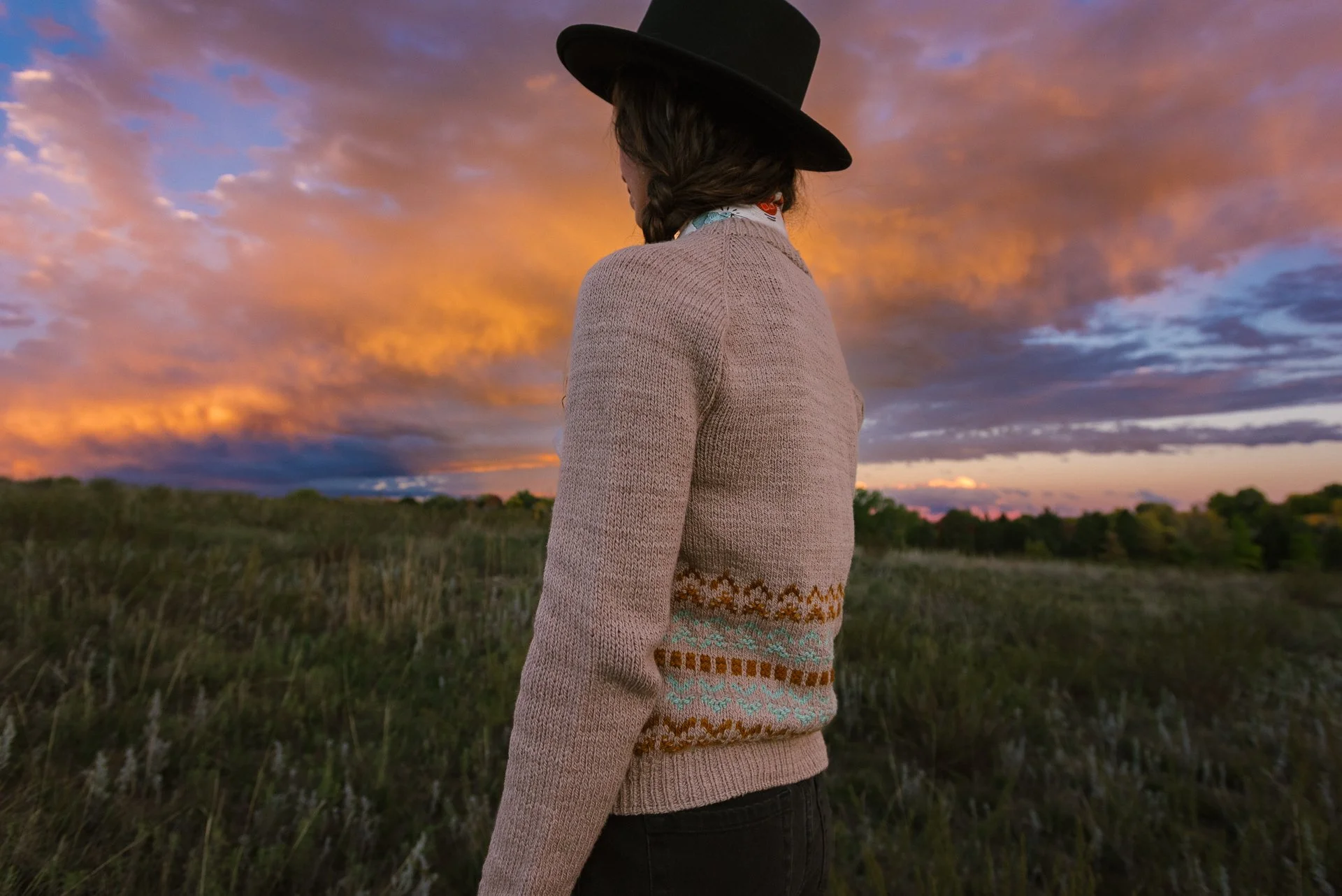
Hidden Lake Cardigan
THE IDEA FOR THIS CARDIGAN began at an alpine lake one autumn afternoon. As I hiked past the water’s edge, the reflection of golden aspens and blue sky on the surface of the gently rippling water created a beautiful abstract pattern. I paused for a few minutes, captivated by how the shapes bent and shimmered. I snapped a photo to remember the moment—and to see if I could later capture those shapes and feelings in fabric form—and continued on my way.
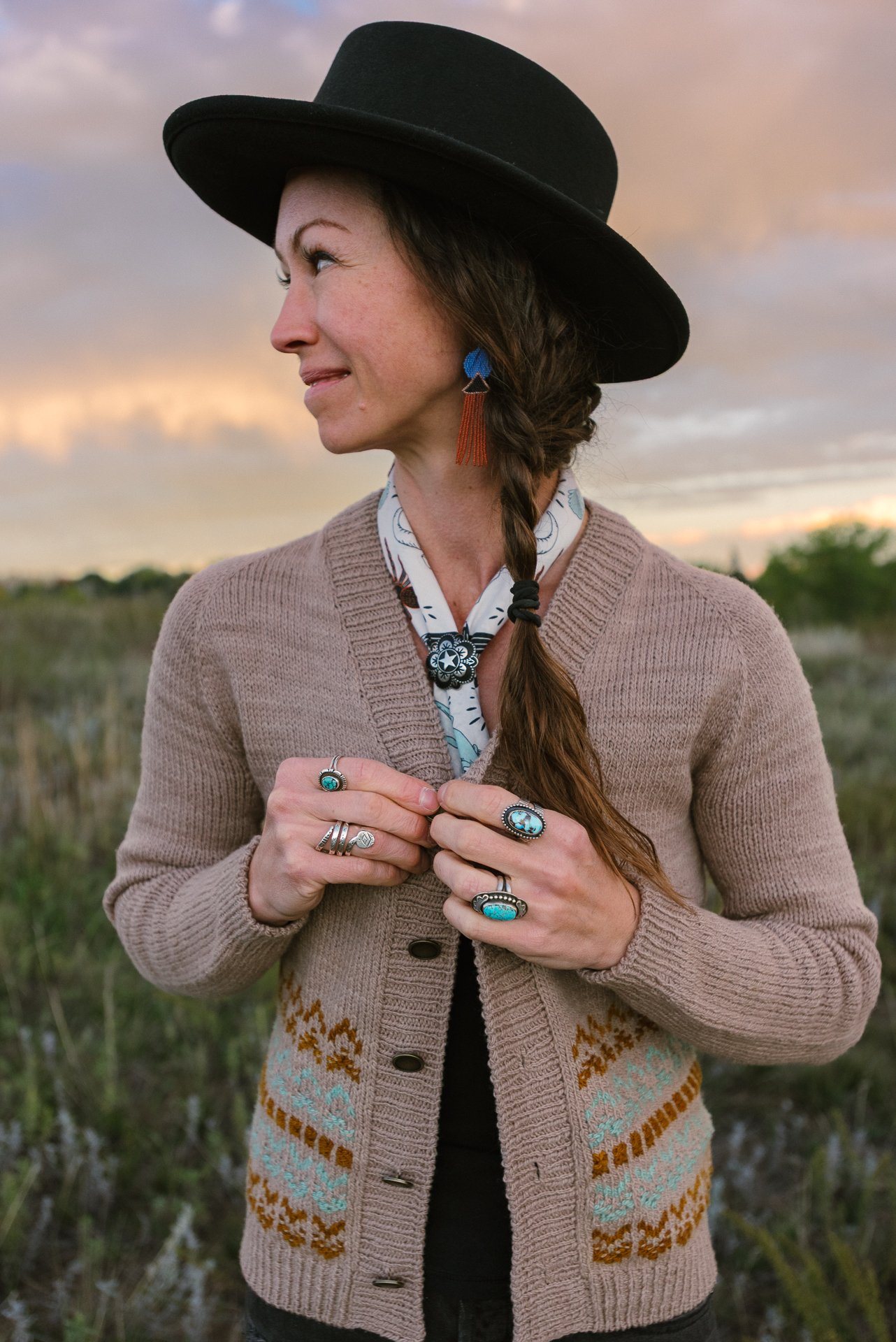
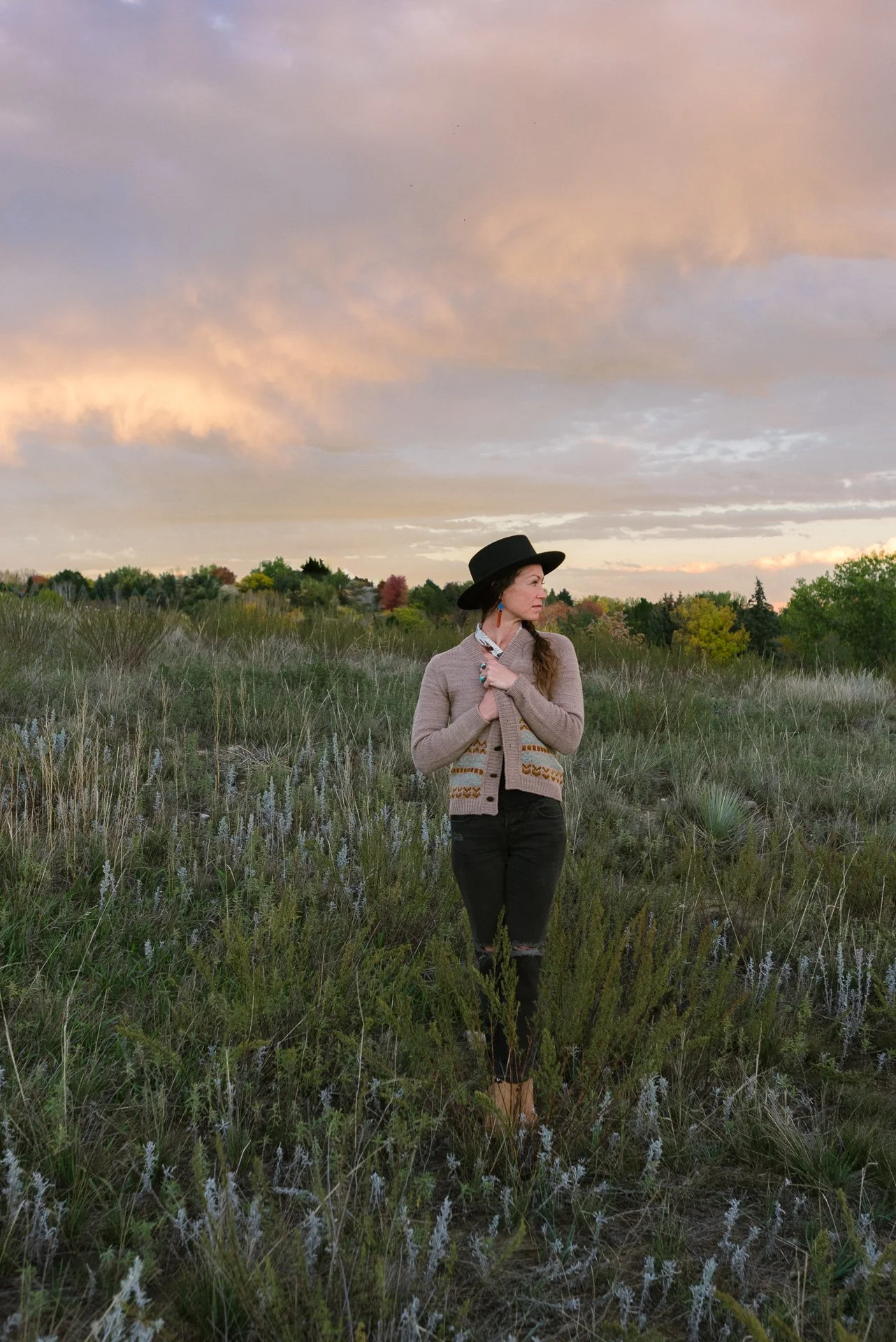
Later, I translated that rippling landscape into a colorwork motif using mosaic knitting—a rhythmic interplay of knits and purls that echo both the texture and movement of the water. I love that this technique doesn’t just depict water’s motion, but also captures its quiet, meditative rhythm in every row. The mosaic patterning flows across the lower body, a part of the garment that moves naturally with the wearer, creating a motif that feels alive and fluid. Classic raglan shaping and simple 1x1 ribbing at the cuffs, hem, and button band keep the rest of the cardigan understated, allowing the colorwork to take center stage. While I used 2 contrast colors to represent the autumn leaves and sky, a single color-shifting yarn would also be a gorgeous choice for a contrast color!
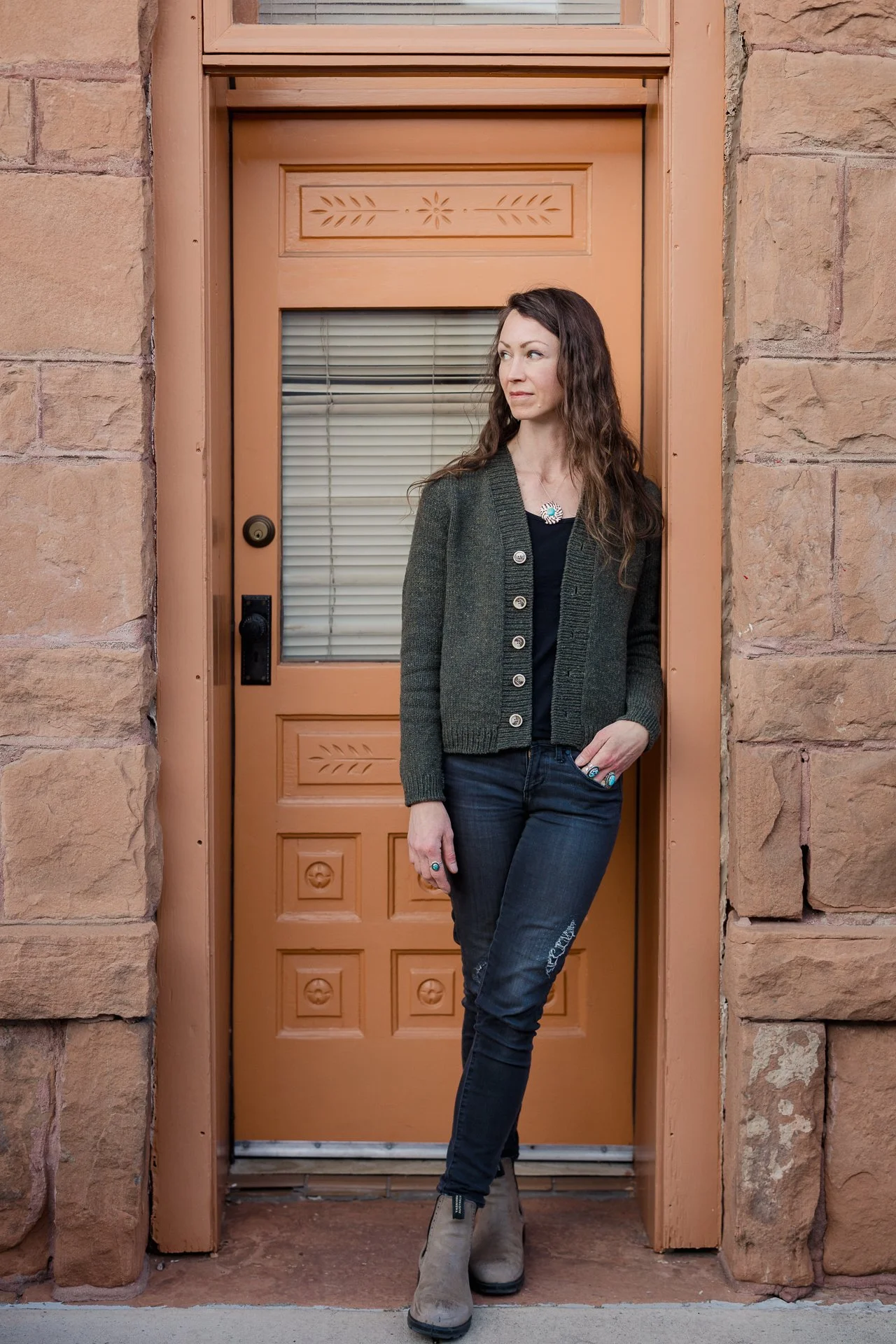
P.S. If you happen to be a stockinette lover, I’ve included alternative instructions for a simple, solid-color version!
-
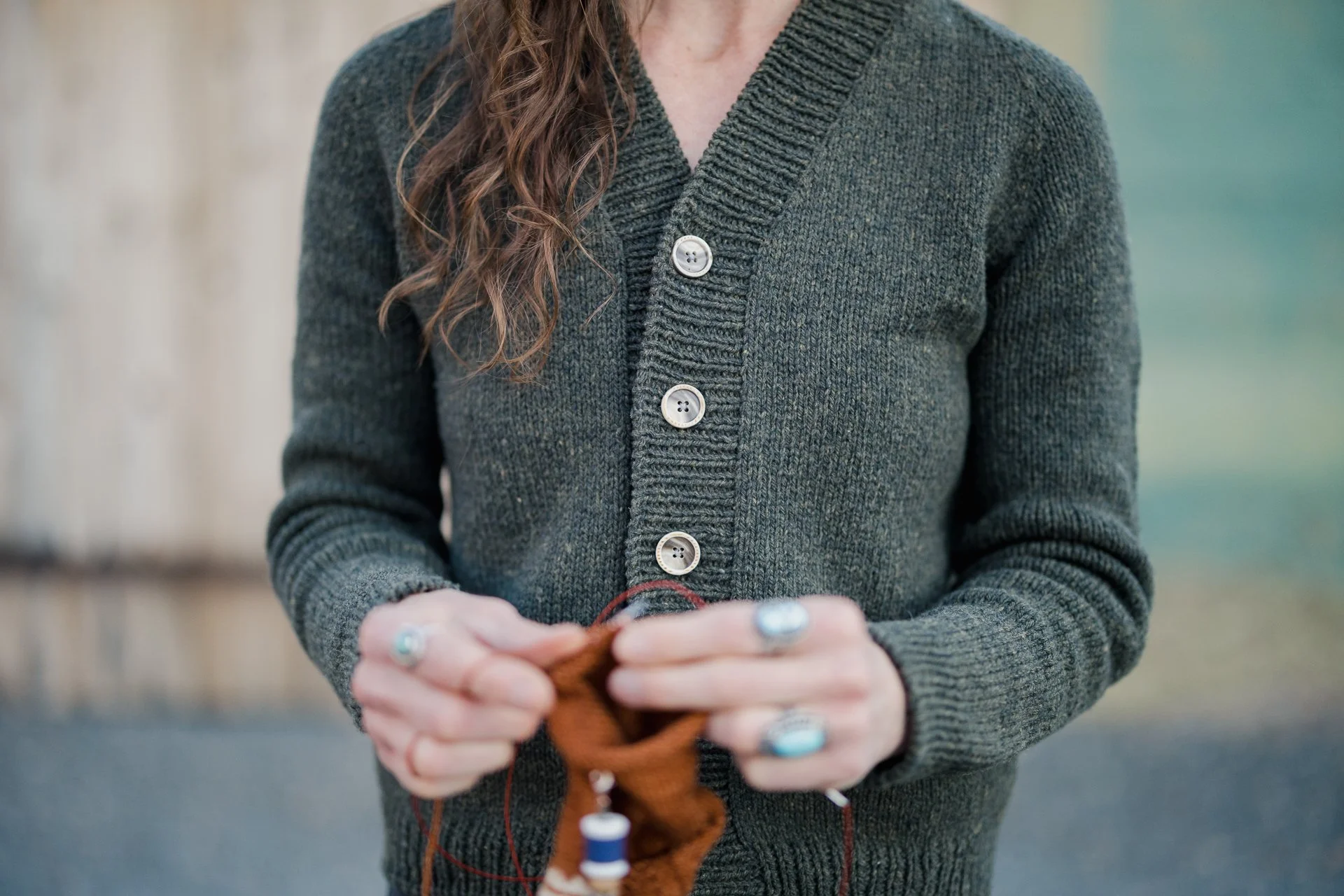
Design: The Hidden Lake Cardigan is a seamless raglan design with gentle v-neck shaping that creates a flattering, everyday silhouette. The hem, cuffs, and button band are finished in classic 1x1 ribbing for a clean and structured edge. Traditional tapered sleeves provide a timeless fit, balancing the bold lower body detail—a wide band of mosaic colorwork worked in two contrasting colors. The slipped-stitch technique makes the colorwork striking yet approachable, with no need to carry multiple strands across the row. Instructions are also included for a solid color version for knitters that wish to omit the colorwork.
Construction: This sweater is knit seamlessly from the top down. Stitches are cast on at the bottom of the button band, and back neck shaping is worked simultaneously with the initial raglan increases. Once the yoke is complete, sleeve stitches are placed on hold while the body is knit. Optional mosaic colorwork is worked on the lower body. The sleeves are then returned to the needles and finished in the round. Finally, stitches are picked up to work the button band.
Fit: This garment is designed to be worn with 1 to 5 in. (2.5 to 12.5 cm) of positive ease in the body. To determine your ideal size, begin by measuring your upper bust (just under the arms, above the full bust). Then add your desired amount of ease and select the size with a finished chest circumference closest to that total. If you are unfamiliar with choosing garment size based on your upper bust measurement, One Wild Designs has a great blog post about this.
Yarn: The yarn estimates provided in this pattern are approximations, calculated to allow for both a sizable swatch and the sweater, with a small margin of error. Your actual yarn usage may vary based on factors such as your personal gauge, the yarn’s characteristics (e.g., fiber content, ply, thickness), and any modifications you make to the pattern.
Stitch Patterns: The stranded mosaic stitch patterns in this sweater are only charted, so you should be confident in your chart reading skills—or be open to learning!
-
SIZES
(1, 2, 3)(4, 5, 6)(7, 8, 9)FINISHED MEASUREMENTS
Finished Chest Circumference
(34.25, 39, 43.75)(46.25, 51, 55.75)(58.25, 63, 67.75) in.
(85.5, 97.5, 109.5)(115.5, 127.5, 139.5)(145.5, 157.5, 169.5) cmFinished Upper Arm Circumference
(11.5, 12.5, 13.25)(14, 15.5, 17.25)(18.5, 20, 21.5) in.
(29, 31.5, 33)(35, 39, 43)(46.5, 50, 54) cmThis sweater is designed to be worn 1 to 6 in. (2.5 to 15 cm) of positive ease in the body. See the note above on fit for more information about choosing the right size for you!
-
YARN
This sweater can be knit with or without colorwork on the lower body, depending on your preference. For the colorwork version, you will need a main color (MC) and two contrast colors (CC1 and CC2). For the solid version, only a single color is required. The amount of MC yarn needed is the same for both versions.DK Weight
MC (Cropped Length): (415, 475, 530)(565, 620, 695)(735, 810,
885) g/(1060, 1210, 1350)(1440, 1580, 1770)(1875, 2065, 2255) yds or (970, 1105, 1235)(1315, 1445, 1620)(1715, 1890, 2060) m
MC (Full Length): (460, 520, 585)(615, 680, 755)(795, 875,
955) g/(1175, 1325, 1490)(1570, 1735, 1925)(2025, 2230, 2435) yds or (1075, 1210, 1360)(1435, 1585, 1760)(1850, 2040, 2225) m
CC1: (20, 25, 30)(30, 35, 35)(40, 40, 45) g/(50, 65, 75)(75, 90, 90)(100, 100, 115) yds or (45, 60, 70)(70, 80, 80)(90, 90, 105) m
CC2: (20, 25, 30)(30, 35, 35)(40, 40, 45) g/(50, 65, 75)(75, 90, 90)(100, 100, 115) yds or (45, 60, 70)(70, 80, 80)(90, 90, 105) mSUGGESTED YARN
Colorwork Version
The Farmer’s Daughter Fibers Pishkun (100 g/255 yds (233 m)) – 100% Montana & Wyoming Rambouillet
MC (Cropped Length): (5, 5, 6)(6, 7, 7)(8, 9, 9) skeins
MC (Full Length): (5, 6, 6)(7, 7, 8)(8, 9, 10) skeins
CC1: 1 skein
CC2: 1 skeinThe colorwork sample sweater is knit in the colorways Elk Antler (MC), Eagle Eye (CC1), and Ranch Romance (CC2).
Solid Color Version
Cascade Merino DK (100 g/254 yds (232 m)) – 100% Merino
Yarn requirements are the same as listed above for the Colorwork Version MC.The solid color sample sweater is knit in the colorway 29 Olive Heather.
-
Needle A (body & sleeves): US 6 (4 mm)
Needle B (ribbing): US 4 (3.5 mm)For each needle size, you will need circular needles measuring 24 in. (60 cm) to 50 in. (125 cm), depending on the finished chest circumference of your chosen size and your preferred method for smaller circumference knitting (such as magic loop, short circular needles, or double-pointed needles).dle A (body): US 6 (4 mm)
Needle B (ribbing): US 5 (3.75 mm)For each needle size, you will need circular needles measuring 24 in. (60 cm) to 50 in. (125 cm), depending on the finished chest circumference of your chosen size and your preferred method for smaller circumference knitting (such as magic loop, short circular needles, or double-pointed needles).
-
Measure gauge on Needle A knit flat, after blocking.
20 sts and 28 rows = 4 in. (10 cm) in stockinette
20 sts and 44 rows = 4 in. (10 cm) in mosaic colorwork -
Knitting
Purling
Increasing
Decreasing
Lifted Increases
Raglan yoke construction
Top-down construction
Knitting flat
Button band
German twisted cast-on
Mosaic knitting
Slipped stitches
Textured knitting
Chart reading
Backwards loop cast-on
Picking up stitches
Tubular bind-off