

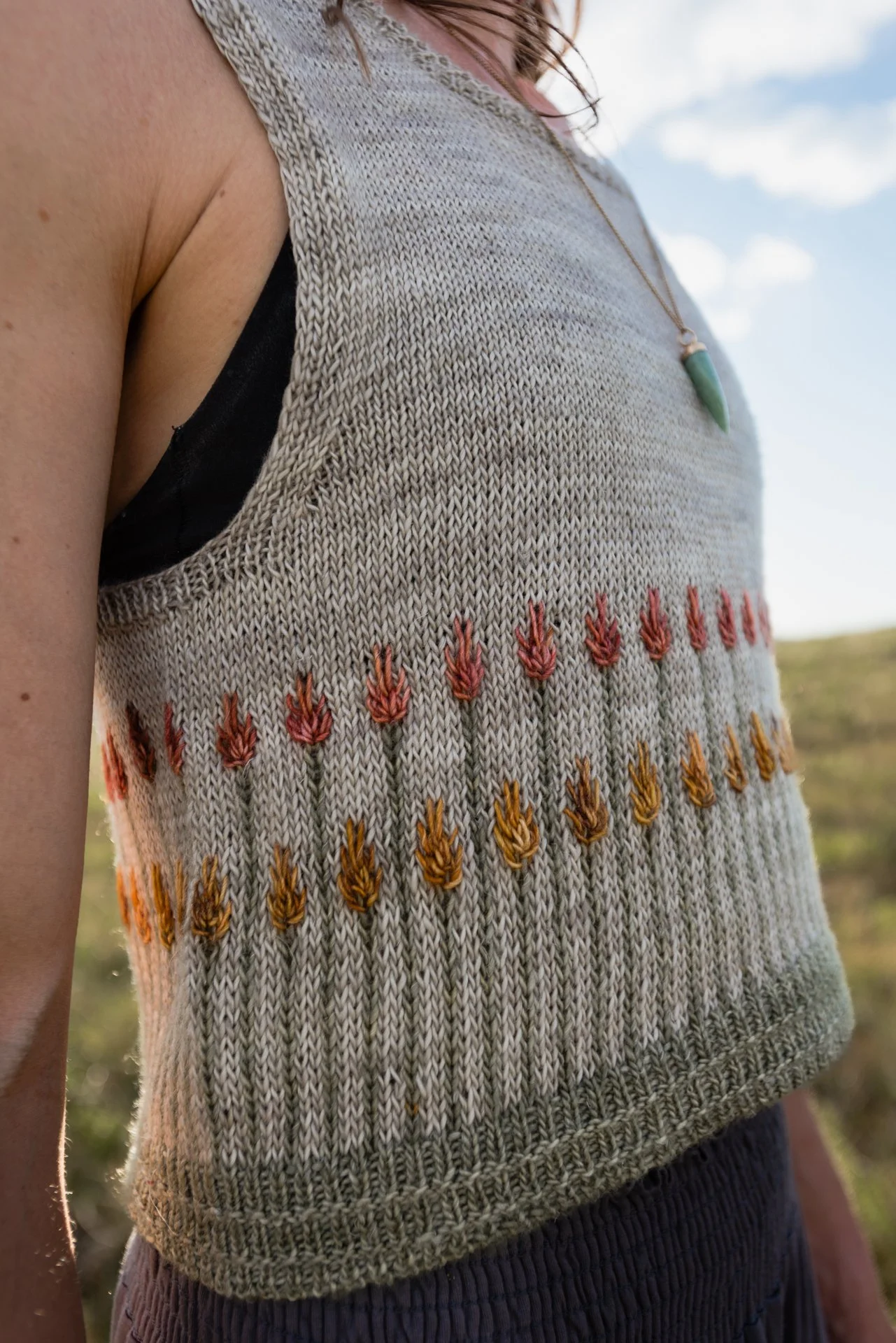


Paintbrush Tank
EVERY TIME I ENCOUNTER a paintbrush flower, I can’t help but momentarily lose my breath. It feels like some kind of miracle that these springy bursts of color could be real, living things. Paintbrush flowers, members of the genus Castilleja, are a symbol of transformation, inner knowing, and creativity.
Paintbrush also happen to be hemi-parasitic, which means that they photosynthesize and produce some of their own energy, but also rely on host plants to supply most of their nutrition. To access these resources, Castilleja possess specialized root-like structures, called haustoria, which pierce the roots of unsuspecting host plants to siphon off nutrients. Interestingly, this interaction is not one-dimensional. Ecological studies indicate that host plants can influence the characteristics of paintbrush plants that parasitize them, affecting their growth or how attractive the paintbrush flowers are to pollinators. For example, when parasitizing lupines, which are nitrogen-fixing legumes, paintbrush often produce more seeds and attract more pollinators compared to paintbrush that parasitize grasses. The bright red and orange colors of the paintbrush flower, when paired with the purple of lupine hosts, may also attract more pollinators together than when the two are apart. In nutrient-poor ecosystems, paintbrush can support higher rates of nutrient cycling because they produce high-quality plant litter once they die, making scarce nutrients available to nearby plants. More recent research has investigated how hemi-parasitic plants may foster diverse soil microbe communities, which can confer benefits to the entire landscape.
I am an ecologist by training, so I can certainly nerd out on this type of thing. But I love how these kinds of associations in the natural world show us that relationships between living things are more intricate and nuanced than we might realize. I’ve started thinking about this when I see paintbrush flowers now: how these bright jewels of subalpine summer are harbingers of a vast connected world underfoot. They remind me to breathe a little deeper, walk with a little more reverence, and not to resist gratitude when it ripples through my bones.
-
Design: The Paintbrush Tank is a boxy, slightly cropped tank top with sporty shaping like a “muscle tank.” Stranded colorwork and slipped stitches on the lower body create a field of paintbrush flowers. The extended armhole drop allows plenty of air flow and freedom of movement on hot summer days. The neckband and hem feature 1x1 broken ribbing.
Construction: This tank is worked from the bottom up. The hem and lower body are worked in the round. Stitches are then divided for the front and back yoke, which are worked flat and joined at the shoulders with an exposed seam. Underarm edging is integrated into the yoke design so that the armholes are finished simultaneously with the yoke. Finally, stitches are picked up to work the neckband.
Fit: This garment is designed to fit with 1 to 5 in. (2.5 to 12.5 cm) of positive ease. To pick the best size for you, measure your upper bust circumference and add your preferred ease of between 1 to 5 in. (2.5 to 12.5 cm). Make the size with a finished chest circumference closest to that number. If you are unfamiliar with choosing garment size based on your upper bust measurement, One Wild Designs has a great blog post about this.
Length: This tank is intended to hit at the top of the hip—just a bit longer than a standard crop length so that you can comfortably move your arms without showing skin.
Stitch Patterns: The paintbrush flower motif is created using a combination of stranded colorwork and slipped stitches. This pattern includes both written and charted instructions for this stitch pattern.
-
SIZES
(1, 2, 3)(4, 5, 6)(7, 8, 9)FINISHED CHEST CIRCUMFERENCE
(33.25, 37, 40.5)(45.25, 49, 52.5)(57.25, 61, 64.5) in.
(83, 92.5, 101.5)(113, 122.5, 131.5)(143, 152.5, 161.5) cmThis tank is intended to be worn with 1 to 5 in. (2.5 to 12.5 cm) of positive ease. Please see the note above on fit!
-
YARN
Fingering weight
MC: (100, 115, 130)(140, 155, 170)(185, 200, 220) g/(395, 455, 510)(550, 610, 670)(730, 790, 865) yds or (360, 415, 465)(505, 560, 615)(670, 720, 790) m
CC1: (30, 35, 40)(45, 50, 55)(60, 65, 70) g/(120, 140, 160)(175, 195, 215)(235, 255, 275) yds or (110, 130, 145)(160, 180, 195)(215, 235, 250) m
CC2: (5 g/20 yds or 18 m)
CC3: (5 g/20 yds or 18 m)SUGGESTED YARN
Miss La Motte Yarn Linum (100 g/395 yds (360 m)) – 90% SW merino wool, 10% linen
MC: (1, 2, 2)(2, 2, 2)(2, 2, 3) skeins
CC1: 1 skein
CC2: 1 skein
CC3: 1 skeinhe sample tank is knit in the colorways Linen (MC), Renosterbos (CC1), Cedar Rouge (CC2), and Autumn Vine (CC3).
-
Needle A (body): US 3 (3.25 mm)
Needle B (ribbing): US 2 (2.75 mm)For each needle size, you will need 24 in. (60 cm) to 50 in. (125 cm) circular needles and your preferred needles for smaller circumference knitting.
-
Measure gauge on Needle A, after blocking. Gauge should be the same knit both flat and in the round.
26 sts and 34 rows = 4 in. (10 cm) in stockinette
26 sts and 28 rows = 4 in. (10 cm) in stranded colorwork -
Tubular cast-on, stranded colorwork, chart reading, knit increases and decreases, German short rows, three needle bind-off, picking up stitches, tubular bind-off